


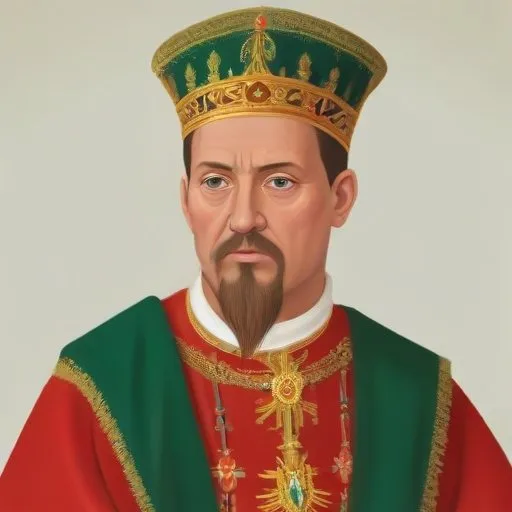
King of Hungary and Croatia from 1272 to 1290, known for his tumultuous reign marked by power struggles, wars, and a decline in royal authority.
Ladislaus IV, also known as Ladislaus the Cuman, is famously recognized as the King of Hungary and Croatia from 1272 to 1290. His reign was marked by internal power struggles, conflicts with neighboring countries, and a unique connection to the pagan Cumans, a nomadic tribe that settled in Hungary.
At the tender age of seven, Ladislaus was married to Elisabeth, a daughter of King Charles I of Sicily. However, his early life was soon marred by turmoil when a rebellious lord, Joachim Gutkeled, kidnapped and imprisoned him at the age of nine. This captivity lasted until his father, Stephen V, passed away in 1272.
During his minority, Ladislaus's kingdom was plagued by internal conflicts between powerful barons, including the Abas, Csks, Kszegis, and Gutkeleds. It wasn't until 1277, when Ladislaus was declared of age, that he began to assert his authority.
Ladislaus formed an alliance with Rudolf I of Germany against Ottokar II of Bohemia, which led to a significant victory in the Battle on the Marchfeld in 1278. This triumph solidified Ladislaus's position as a formidable force in the region.
Despite this success, Ladislaus struggled to restore royal power in Hungary. He faced opposition from the papal legate, Philip, bishop of Fermo, who was appalled by the presence of pagan Cumans in Hungary. This led to a series of power struggles, excommunications, and imprisonments that marred Ladislaus's reign.
Ladislaus's connection to the Cumans was a defining aspect of his reign. His mother, Elizabeth, was the daughter of a Cuman chieftain, and Ladislaus often found himself torn between his Christian duties as king and his loyalty to the pagan Cumans.
When the Cumans refused to adopt a Christian lifestyle, Ladislaus supported their right to maintain their traditional way of life. This decision led to widespread criticism and accusations that he was inciting the Mongols to invade Hungary.
In the latter part of his reign, Ladislaus faced numerous challenges, including a Cuman invasion in 1282 and a Mongol invasion in 1285. He managed to vanquish the Cumans, but his kingdom was left weakened and divided.
Ladislaus's tumultuous reign came to an end on July 10, 1290. His legacy is marked by controversy and upheaval, but he remains an important figure in Hungarian and Croatian history, remembered for his complex relationships with the Cumans and his struggles to maintain power in a tumultuous era.
Born in 1361
King of Bohemia from 1378 to 1419, known for his tumultuous reign marked by power struggles, conflicts, and a Black Death pandemic. He was a key figure in the Luxembourg dynasty.
Born in 1310
The last Piast king of Poland, who reformed the country's judicial system, established universities, and promoted trade and commerce, earning him the title "the Great".
