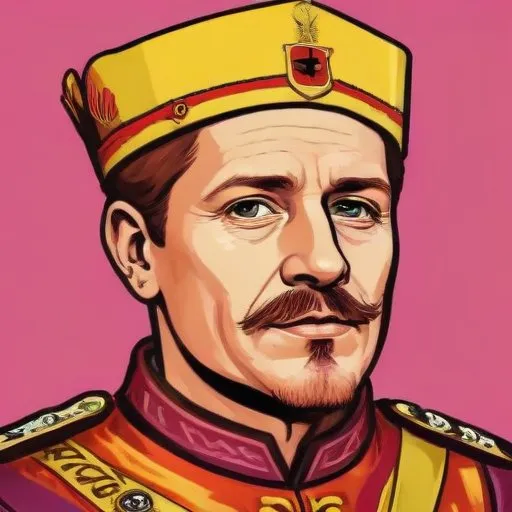
Rudolf I of Germany: The First King of Germany from the House of Habsburg
The Rise of the Habsburg Dynasty
Rudolf I of Germany, also known as Rudolf of Habsburg, was a trailblazer in every sense. He was the first King of Germany from the House of Habsburg, reigning from 1273 until his death in 1291. This marked the end of the Great Interregnum, a period of 23 years without an emperor, which had begun after the death of Emperor Frederick II in 1250.
Early Life and Count of Habsburg
Born on May 1, 1218, at Limburgh Castle near Sasbach am Kaiserstuhl in southwestern Germany, Rudolf was the son of Count Albert IV of Habsburg and Hedwig, daughter of Count Ulrich of Kyburg. At the tender age of 14, he was given as a squire to his uncle, Rudolf I, Count of Laufenburg, to train in knightly pursuits. Upon his father's death in 1239, Rudolf inherited vast estates around the ancestral seat of Habsburg Castle in the Aargau region of present-day Switzerland, as well as in Alsace.
Rise to Power and Conquests
Rudolf's ambition and strategic thinking led him to acquire the duchies of Austria and Styria in opposition to his mighty rival, the Premyslid king Ottokar II of Bohemia. He defeated Ottokar in the 1278 Battle on the Marchfeld, a victory that would cement the Habsburgs' position in the region for centuries to come. This marked a significant turning point in Rudolf's career, as he successfully established himself as a powerful force in German politics.
Legacy and Impact on Modern Society
Rudolf's reign had a profound impact on the course of German history. He played a vital role in raising the comital House of Habsburg to the rank of Imperial princes, paving the way for the Habsburgs to become one of the most influential royal houses in Europe. The territories he acquired, including Austria and Styria, remained under Habsburg rule for over 600 years, forming the core of the Habsburg monarchy and the present-day country of Austria.
Personal Milestones and Key Life Events
- In 1240, Emperor Frederick II granted Schwyz Reichsfreiheit in the Freibrief von Faenza, attempting to limit Rudolf's growing power.
- In 1242, Rudolf invaded the domains of Hugh of Tuffenstein, killing him in the process.
- In 1244, he gained control of Lake Lucerne and reasserted his dominance in the region.
Historical Context and Comparative Analysis
Rudolf's achievements must be viewed in the context of the tumultuous medieval period in which he lived. His rise to power was marked by rivalries, power struggles, and conflicts with neighboring kingdoms. Despite these challenges, he demonstrated remarkable resilience and cunning, outmaneuvering his opponents to secure his position.
Trivia and Fun Facts
- Rudolf's election as King of Germany marked the beginning of the Habsburgs' long reign, which would last until the 20th century.
- He was known for his intelligence, strategic thinking, and diplomatic skills, which helped him navigate the complex web of alliances and rivalries in medieval Europe.
Conclusion
Rudolf I of Germany was a visionary leader who left an indelible mark on German history. His rise to power, military conquests, and strategic alliances established the Habsburgs as a dominant force in European politics, shaping the course of history for centuries to come. As we reflect on his life and legacy, we are reminded of the significance of strong leadership, diplomacy, and strategic thinking in shaping the course of human events.
FAQ
What was Rudolf I of Germanys significance in German history?
Rudolf I of Germany was a king of the Romans and the first king of Germany from the House of Habsburg. He played a crucial role in shaping Germanys history, defeating Ottokar II of Bohemia and expanding Habsburg territories.
How did Rudolf I of Germany acquire the throne?
Rudolf I of Germany acquired the throne through a complex web of alliances and negotiations, eventually being crowned king by the German electors in 1273.
What was Rudolf I of Germanys relationship with the Holy Roman Empire?
Rudolf I of Germany was a key figure in the Holy Roman Empire, working to strengthen its power and influence. He was crowned King of the Romans, a title that symbolized his authority over the empire.
Did Rudolf I of Germany have any notable military campaigns?
Yes, Rudolf I of Germany led several military campaigns, including the Battle of Marchfeld in 1278, which resulted in the defeat of Ottokar II of Bohemia and the expansion of Habsburg territories.
What was Rudolf I of Germanys legacy?
Rudolf I of Germanys legacy was marked by his ability to establish the Habsburgs as a powerful force in German politics, setting the stage for their future dominance in European history.