


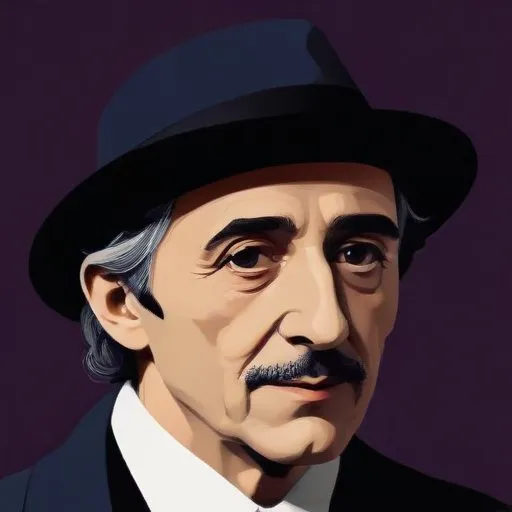
An Italian poet, philosopher, and activist who founded the Community of the Ark, a network of intentional communities promoting nonviolence and simple living. He's known for his Gandhian-inspired philosophy and activism.
Imagine a world where people from diverse backgrounds come together to promote peace, understanding, and nonviolence. This was the vision of Lanza del Vasto, a Italian philosopher, poet, artist, and activist who dedicated his life to spreading the message of love and compassion. He is best known for being a Western disciple of Mahatma Gandhi and his tireless efforts to promote interreligious dialogue, spiritual renewal, and ecological activism.
Born on September 29, 1901, in San Vito dei Normanni, Italy, Lanza del Vasto was raised in a family that valued education and spirituality. His father, Don Luigi Giuseppe Lanza di Trabia-Branciforte, was Sicilian, while his mother, Anne-Marie Henriette Nauts-Oedenkoven, was Belgian. This multicultural upbringing had a profound impact on Lanza's worldview, shaping his future endeavors.
In 1936, Lanza traveled to India to join the movement for Indian independence led by Mahatma Gandhi. This encounter had a profound impact on Lanza's life and philosophy. He spent six months with Gandhi, learning about nonviolent resistance and the importance of simplicity, self-discipline, and compassion. In June 1937, Lanza embarked on a pilgrimage to the sources of the Ganges and Yamuna rivers in the Himalayas, where he had a vision that guided him to return to Europe and spreading Gandhi's message.
In 1948, Lanza founded the Community of the Ark, a spiritual community dedicated to promoting nonviolence, ecology, and interreligious dialogue. The community faced numerous challenges, but Lanza's perseverance and vision kept it alive. In 1954, he returned to India to participate in nonviolent antifeudal struggles with Vinoba Bhave. The Community of the Ark eventually settled in Haut-Languedoc, France, where it continued to thrive until the 1990s.
Lanza del Vasto's philosophy revolved around the principles of nonviolence, love, and compassion. He believed that individuals had the power to change the world through collective action and self-reflection. His work emphasized the importance of interreligious dialogue, ecological activism, and spiritual renewal. Lanza's poetry and writings also reflected his deep sense of spirituality and connection with nature.
Lanza del Vasto's impact on modern society is undeniable. His work inspired a generation of activists, philosophers, and spiritual leaders. His emphasis on nonviolence and interreligious dialogue paved the way for future movements, such as the Civil Rights Movement in the United States. Lanza's legacy continues to inspire individuals and communities around the world to work towards a more peaceful and harmonious world.
Lanza del Vasto's legacy extends far beyond his own community. He has inspired generations of activists, philosophers, and spiritual leaders to work towards a more peaceful and harmonious world. His emphasis on nonviolence, interreligious dialogue, and ecological activism has left a lasting impact on modern society. As we continue to face the challenges of our time, Lanza del Vasto's vision and philosophy remain a beacon of hope for a brighter future.
97 Years Old
A prominent leader in the civil rights movement, advocating for racial equality and social justice through nonviolent means, leaving a lasting impact on American history.
Born in 1913
A French novelist, philosopher, and journalist who wrote influential works like "The Stranger" and "The Plague", exploring absurdism and the human condition.
Born in 1905
Existentialist philosopher and playwright who argued that humans have complete freedom to choose their actions and create their own meaning in life, influencing modern thought on morality and individual responsibility.
Born in 1908
A pioneering feminist philosopher who wrote extensively on ethics, politics, and gender, famously arguing that "one is not born, but rather becomes, a woman."
Born in 1896
French poet and author who founded Surrealism, a cultural movement that explored the subconscious and the world of dreams. He wrote novels, poems, and essays that continue to influence art and literature today.
Born in 1901
A French historian, theorist, and author who wrote influential novels and essays on art, politics, and human condition, exploring the complexities of modern society.
99 Years Old
A Colombian journalist and author who crafted magical realism, a literary style that blends fantasy and reality, and won the Nobel Prize in Literature in 1982. His works are known for their vivid storytelling and exploration of human experience.
Born in 1900
A German psychologist and sociologist who developed the concept of "social character" and explored the relationship between psychology and society, known for his humanistic and socialist approach.
