


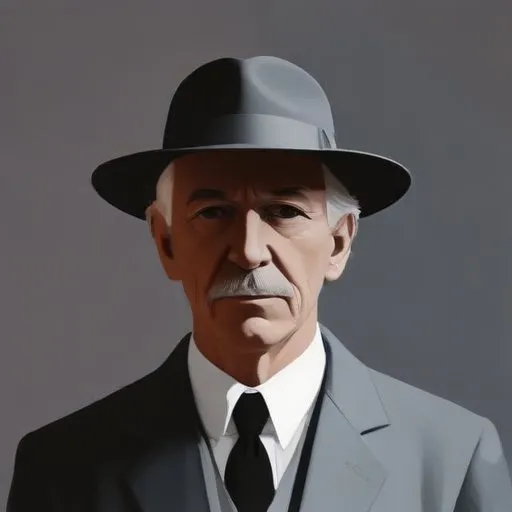
A pioneering figure in Canadian modern art, known for vibrant, abstract landscapes that evoke a sense of spirituality and connection to nature.
Lawren Harris is renowned as a pioneering Canadian painter, best known for his instrumental role as a leading member of the Group of Seven, a collective of landscape artists who sought to break away from traditional European art forms and forge a distinctively Canadian style. Through his innovative and evocative works, Harris played a pivotal role in shaping the trajectory of Canadian art, earning himself a reputation as a visionary in the realm of landscape art.
Born on October 23, 1885, in Brantford, Ontario, Harris was the son of Thomas Morgan Harris and Annabelle Stewart. His father's position as secretary to the firm of A. Harris, Sons & Company Ltd. ensured a life of comfort and financial security for Harris, allowing him to pursue his artistic passions without constraint. Following his father's death in 1894, Harris's family relocated to Toronto, where he began boarding at St. Andrews College in 1899. He subsequently attended University College at the University of Toronto, before embarking on a four-year sojourn in Berlin to study under renowned artists Adolf Schlabitz, Franz Skarbina, and Fritz von Wille.
Harris's time in Berlin proved instrumental in shaping his artistic vision, as he delved into the realms of Impressionism and Post-Impressionism, and was exposed to a plethora of modern art exhibitions, including those of the Berlin Secession. This exposure instilled in him a deep appreciation for the avant-garde movements of the time, which he would later incorporate into his own unique style. Upon his return to Toronto in 1908, Harris became an integral member of the Arts and Letters Club, where he forged lasting friendships with like-minded individuals, including journalist Roy Mitchell.
Harris's association with the Group of Seven, a collective of artists bound together by their desire to promote a distinctly Canadian art form, marked a pivotal turning point in his career. Alongside fellow members, including J.E.H. MacDonald, F.H. Johnston, and A.Y. Jackson, Harris embarked on a series of seminal expeditions to the Canadian wilderness, capturing the rugged beauty of the landscape through his works. His innovative use of color and form, characterized by bold, vibrant hues and simplified, geometric forms, imbued his paintings with a sense of spiritual and emotional depth, earning him widespread acclaim.
Harris's artistic vision was deeply rooted in his philosophical beliefs, which were influenced by Theosophy and the concept of the spiritual in art. He believed that art should serve as a conduit for the transcendental, capturing the essence of the natural world and conveying it to the viewer. This conviction was reflected in his paintings, which often featured abstracted, symbolic forms and a muted color palette, evoking a sense of mystery and contemplation.
Lawren Harris's contributions to Canadian art are immeasurable, and his influence can be seen in the works of numerous artists who followed in his footsteps. As a visionary, innovator, and champion of a distinctly Canadian art form, Harris's legacy continues to inspire and captivate audiences to this day. His paintings, characterized by their bold, expressive brushstrokes and profound sense of emotional depth, remain an indelible part of Canada's cultural heritage.
Harris received numerous accolades during his lifetime, including an honorary doctorate from the University of Toronto in 1962. He was also elected a member of the Royal Canadian Academy of Arts in 1911.
Harris married Bess Larkin Housser in 1910, and the couple had three children together. Following Bess's death in 1965, Harris married Margaret Robertson in 1967. He passed away on January 29, 1970, at the age of 84, leaving behind a rich legacy of artistic innovation and cultural significance.
Born in 1873
A pioneering figure in Canadian art, known for vibrant, expressive landscapes that captured the country's rugged beauty and spirit.
Born in 1882
A prominent figure in Canadian art, known for capturing the country's rugged landscapes and founding the Group of Seven, a collective of artists who shaped the nation's artistic identity.
Born in 1898
A member of the Group of Seven, a renowned collective of landscape painters, known for capturing the majesty of the Canadian wilderness through vibrant, expressive works.
Born in 1871
A pioneering artist and writer who explored the indigenous cultures of the Pacific Northwest, capturing their stories and landscapes through vibrant paintings and poignant writings.
Born in 1877
A pioneering landscape painter who captured the essence of the Canadian wilderness, inspiring a generation of artists with his bold, expressive brushstrokes.
