


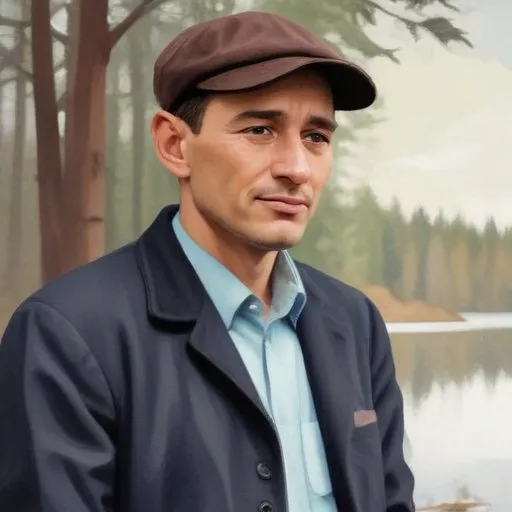
A pioneering landscape painter who captured the essence of the Canadian wilderness, inspiring a generation of artists with his bold, expressive brushstrokes.
Raised in rural Ontario, Thomson's early life was far from artistic. Born into a large family of farmers, he showed no immediate signs of artistic talent. However, after attending business college, he developed skills in penmanship and copperplate writing, which eventually led him to work as a pen artist at several photoengraving firms in Seattle and Toronto.
In May 1912, Thomson's life took a dramatic turn when he visited Algonquin Park, a vast public park and forest reservation in Central Ontario. It was here that he acquired his first sketching equipment and began to capture the beauty of nature, following the advice of his friend and fellow artist, J.E.H. MacDonald.
This newfound passion for art led Thomson to return to Algonquin Park repeatedly, spending his winters in Toronto and the rest of the year in the park. His early paintings, though not technically impressive, showed a strong grasp of composition and color handling.
As Thomson's skills matured, his paintings became more striking, with vivid colors and thickly applied paint. His later works, such as "The Jack Pine" and "The West Wind," have become iconic representations of Canadian art, capturing the essence of the country's natural beauty.
Thomson's untimely death by drowning in 1917, at just 39 years old, was a tragedy for Canadian art. However, his legacy lived on, inspiring the formation of the Group of Seven, a collective of Canadian artists who sought to capture the country's unique landscapes and natural beauty.
Today, Thomson's paintings are celebrated across Canada, with many considering him one of the country's most important artists. His work continues to inspire new generations of artists, photographers, and nature enthusiasts, cementing his place in Canadian art history.
Thomson's life was marked by a deep love for nature and a passion for art. Though his life was cut short, his legacy continues to inspire and captivate audiences across Canada and beyond.
"Art is the only way to run away without leaving home." - Tom Thomson
This quote, often attributed to Thomson, captures the essence of his artistic vision, which sought to capture the beauty of the natural world and bring it back to the viewer.
Born in 1885
A pioneering figure in Canadian modern art, known for vibrant, abstract landscapes that evoke a sense of spirituality and connection to nature.
Born in 1873
A pioneering figure in Canadian art, known for vibrant, expressive landscapes that captured the country's rugged beauty and spirit.
Born in 1882
A prominent figure in Canadian art, known for capturing the country's rugged landscapes and founding the Group of Seven, a collective of artists who shaped the nation's artistic identity.
Born in 1871
A pioneering artist and writer who explored the indigenous cultures of the Pacific Northwest, capturing their stories and landscapes through vibrant paintings and poignant writings.
