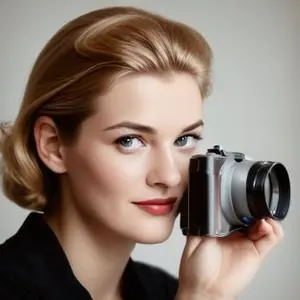
Lee Miller: The Fearless Photographer Who Captured the Essence of War and Fashion
A Pioneering Spirit in Photography
Lee Miller, a renowned American photographer and photojournalist, is best known for her captivating images that chronicled the tumultuous years of World War II, as well as her stunning work in the world of high fashion. With an uncanny ability to capture the essence of her subjects, Miller's photographs continue to inspire and awe art enthusiasts to this day.
A Turbulent Childhood and Early Life
Born on April 23, 1907, in Poughkeepsie, New York, Miller's life was marked by turmoil from an early age. She was the victim of rape at the tender age of seven, which resulted in a bout of gonorrhea. Her difficulties in traditional education led to her expulsion from several schools in the Poughkeepsie area. However, her father, Theodore Miller, nurtured her interest in photography, often using her as a model for his amateur photographs.
The Path to Paris and Beyond
In 1925, Miller set out for Paris, where she enrolled in the Ladislas Medgyes School of Stagecraft, studying lighting, costume, and design. She later returned to New York and joined an experimental drama program at Vassar College. Her artistic pursuits eventually led her to the Art Students League of New York in Manhattan, where she honed her skills in life drawing and painting.
A Career of Contrasts: Fashion and War
Miller's early career in photography was marked by her work in the fashion world, where she modeled for prominent designers and photographers, including Vogue's Condé Nast. However, it was her experiences during World War II that cemented her reputation as a fearless and talented war photographer. As a correspondent for Vogue, Miller captured the London Blitz, the liberation of Paris, and the atrocities of the concentration camps at Buchenwald and Dachau.
Personal Life and Legacy
Miller's personal life was marked by her marriage to Roland Penrose, a British surrealist artist, and her relationship with her son, Antony Penrose, who played a crucial role in promoting her work after her death. Miller's legacy extends far beyond her own accomplishments, as she paved the way for future generations of female photographers and journalists.
Key Works and Awards
- Lee Miller's War: Beyond D-Day (2005) - a collection of her war photographs
- The Lives of Lee Miller (1985) - a biography by her son, Antony Penrose
- Inducted into the International Photography Hall of Fame and Museum (2013)
Influence on Modern Society
Miller's groundbreaking work has inspired countless photographers, artists, and journalists. Her fearlessness and dedication to capturing the truth have left an indelible mark on the world of photography and beyond. As a pioneering female photographer, Miller's legacy continues to empower women in the arts, ensuring her place as one of the most important photographers of the 20th century.
FAQ
What is Lee Millers photography style?
Lee Millers photography style is characterized by her use of bold composition, experimentation with lighting, and capturing the human experience during wartime. She is known for her surrealist and avant-garde approach to photography.
What is Lee Millers contribution to photography?
Lee Millers contribution to photography is immense, as she was one of the first women photographers to capture the horrors of war. She documented the liberation of Dachau and Buchenwald, providing a unique perspective on the atrocities committed during World War II.
Who was Lee Millers mentor?
Lee Millers mentor was Man Ray, a renowned photographer and artist. He introduced her to the world of photography and encouraged her to experiment with her own style.
What is Lee Millers legacy?
Lee Millers legacy is that of a pioneering female photographer who broke the glass ceiling in a male-dominated profession. Her work continues to inspire photographers, artists, and women around the world.
What are some of Lee Millers famous photographs?
Some of Lee Millers famous photographs include her portraits of Pablo Picasso, Henri Matisse, and other famous artists. Her photographs of the liberation of Dachau and Buchenwald are also highly acclaimed.