


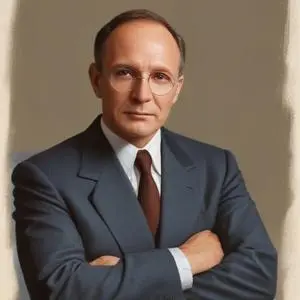
A pioneer in autism research, he identified and described the condition, revolutionizing our understanding of it. His work laid the foundation for modern autism diagnosis and treatment.
Leo Kanner was an Austrian-American psychiatrist, physician, and social activist, best known for his groundbreaking work on infantile autism. In 1943, he published his landmark paper "Autistic Disturbances of Affective Contact," describing 11 children who displayed a powerful desire for aloneness and an obsessive insistence on persistent sameness, thereby coining the term "early infantile autism."
Kanner was born as Chaskel Leib Kanner on June 13, 1894, in Klekotw, Austria-Hungary (present-day Klekotiv, Ukraine), to Abraham Kanner and Clara Reisfeld Kanner. He grew up in a traditional Jewish household, receiving both a religious and secular education. Kanner spent the first years of his life in Klekotw with his family, before moving to Berlin to live with his uncle in 1906.
Kanner practiced as a physician in Germany and South Dakota before working at the Henry Phipps Psychiatric Clinic at the Johns Hopkins Hospital. He was in charge of developing the first child psychiatry clinic in the United States and later served as the Chief of Child Psychiatry at the Johns Hopkins Hospital.
Kanner's work on autism was instrumental in raising awareness and understanding of the condition. His paper "Autistic Disturbances of Affective Contact" described the characteristics of autistic children, including their difficulties with social interaction, communication, and repetitive behaviors. He also emphasized the importance of early diagnosis and treatment.
Kanner co-founded The Children's Guild, a non-profit organization serving children, families, and child-serving organizations throughout Maryland and Washington, D.C. The organization is dedicated to transforming how America cares for and educates its children and youth.
Leo Kanner is widely considered one of the most influential American psychiatrists of the 20th century. His work on autism has had a lasting impact on the field, and his legacy continues to inspire researchers, clinicians, and families affected by the condition.
"Autism is not a disease, it is a way of being. We need to understand and respect it, rather than trying to change it."
In conclusion, Leo Kanner's contributions to the field of psychiatry, particularly in the area of autism research, have had a profound impact on our understanding and treatment of the condition. His legacy continues to inspire and educate future generations of researchers, clinicians, and families.
Born in 1906
An Austrian pediatrician and academic who identified and described autistic psychopathy, now known as Asperger syndrome, and advocated for a more compassionate approach to treating autistic children.
85 Years Old
A pioneering researcher in autism and dyslexia, known for groundbreaking work on the cognitive and neural basis of these conditions, and for developing the "weak central coherence" theory.
98 Years Old
A pioneering autism researcher who developed the concept of Asperger syndrome and advanced our understanding of autism spectrum disorders through her groundbreaking work and advocacy. Her contributions have improved diagnosis, treatment, and acceptance of autistic individuals.
68 Years Old
A renowned psychiatrist and author, known for his groundbreaking work on autism, Asperger's syndrome, and the concept of "empathizing-systemizing" theory. His research has greatly advanced our understanding of neurodiverse conditions.
79 Years Old
A renowned autism spokesperson and innovator in animal behavior, known for designing humane livestock handling systems and advocating for autism awareness.
47 Years Old
A math savant and autistic author, known for holding the European record for reciting the value of pi to 22,514 digits and writing books on his experiences and insights.
74 Years Old
A savant with exceptional memory and calculation abilities, known for his incredible recall of sports trivia, history, and literature, as well as his remarkable math skills.
