


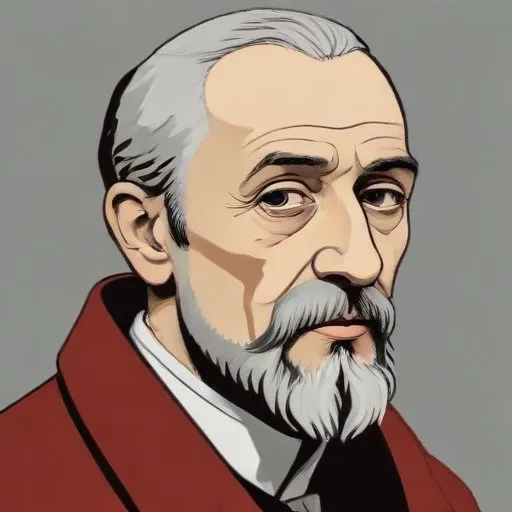
A Polish Renaissance man who excelled in multiple fields, creating innovative art and contributing to mathematical logic, while also exploring philosophical ideas.

Leon Chwistek was a Polish avant-garde painter, art theorist, literary critic, logician, philosopher, and mathematician who made significant contributions to various fields. He is best known for his work in mathematical logic, philosophy of science, and his theory of the multiplicity of realities, which had a profound impact on the development of modern art and philosophy.
Chwistek's academic career began in 1919 when he co-founded the Polish Mathematical Society. He later lectured in mathematics at the Jagiellonian University, where he obtained his habilitation in 1928 in mathematical logic. In 1929, he became a Professor of Logic at the University of Lwów, a position that Alfred Tarski had also applied for.
Chwistek's philosophical contributions centered around his critique of the axiomatic method, which he demonstrated to be inconsistent. He argued that reality cannot be described by a single homogeneous system based on formal logic, as there are multiple realities. This philosophy was later developed in his book, The Limits of Science, published in 1948.
As an artist, Chwistek developed his theory of the multiplicity of realities, which he initially applied to the arts. He identified four basic types of realities, each corresponding to four basic types of painting. This theory had a significant impact on the development of modern art, as it challenged traditional notions of representation and reality.
During World War II, Chwistek remained at the University of Lwów, which was occupied by the Soviet Union. He later joined the Union of Soviet Writers of Ukraine and evacuated to Tbilisi, where he taught mathematical analysis. In 1943, he moved to Moscow, where he became active in the Union of Polish Patriots in the USSR.
Leon Chwistek's contributions to mathematics, philosophy, and art have had a lasting impact on modern thought. His critique of the axiomatic method and his theory of the multiplicity of realities continue to influence philosophers, mathematicians, and artists today. As a polymath, Chwistek's work continues to inspire interdisciplinary approaches to knowledge and creativity.
Leon Chwistek's remarkable career and contributions continue to inspire new generations of thinkers, artists, and mathematicians. His legacy serves as a testament to the power of interdisciplinary approaches to knowledge and creativity.
Born in 1878
Developed a notation system for propositional logic and introduced the concept of many-valued logic, which challenged traditional binary true/false logic. His work laid the foundation for modern computer science and artificial intelligence.
Born in 1901
Developed a rigorous definition of truth and laid the foundations for modern logic, making significant contributions to the fields of mathematics, philosophy, and linguistics.
75 Years Old
A Polish athlete who won Olympic medals in the 400 meters hurdles and 4x400 meters relay at the 1964 Tokyo Olympics, setting multiple national records.
Born in 1925
A renowned sociologist and philosopher who explored the human condition, morality, and the consequences of modernity, particularly in the context of globalization and consumerism.
Born in 1904
A Polish literary mastermind, celebrated for his avant-garde novels and plays that probed the human condition, identity, and the search for meaning. His works are a blend of philosophical inquiry, psychological insight, and dark humor.
