


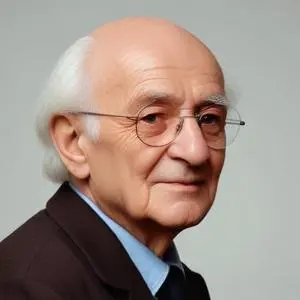
A renowned sociologist and philosopher who explored the human condition, morality, and the consequences of modernity, particularly in the context of globalization and consumerism.
Zygmunt Bauman, the renowned Polish-born sociologist and philosopher, is best known for his groundbreaking work on the concept of liquid modernity, which explores the ever-changing, flexible, and uncertain nature of modern society. Through his extensive research and writings, Bauman has shed light on the complexities of postmodernity, consumerism, and the human experience, making him one of the most influential thinkers of our time.
Born on November 19, 1925, in Poznań, Poland, to a non-observant Jewish family, Bauman's life was marked by turmoil and displacement. During World War II, his family escaped to the Soviet Union, where he enlisted in the Soviet-controlled First Polish Army as a political instructor. Bauman took part in significant battles, including the Battle of Kolberg and the Battle of Berlin, earning the Military Cross of Valour in May 1945.
After the war, Bauman became one of the Polish Army's youngest majors. However, he soon found himself forced to give up his Polish citizenship during the 1968 Polish political crisis. He emigrated to Israel and later settled in England, where he pursued his academic interests at the London School of Economics. Bauman's intellectual journey led him to become Professor of Sociology at the University of Leeds, a position he held until he became emeritus.
Bauman's most significant contribution lies in his concept of liquid modernity, which critiques the notion of modern society as solid, stable, and predictable. Instead, he argues that modernity is characterized by fluidity, fragmentation, and a perpetual state of uncertainty. This idea has far-reaching implications for our understanding of consumerism, social relations, and the human condition.
Bauman's work has had a profound impact on modern society, influencing fields beyond sociology and philosophy. His ideas have shaped the way we think about consumerism, globalization, and the role of technology in shaping human relationships. His critiques of modernity have sparked important discussions about the nature of power, freedom, and inequality.
Bauman has received numerous awards and honors for his contributions to sociology and philosophy, including the European Amalfi Prize for Sociology and Social Sciences (1992) and the Prince of Asturias Award for Communications and Humanities (2010).
Zygmunt Bauman's work continues to inspire scholars, philosophers, and thinkers worldwide. His legacy lies in his ability to illuminate the complexities of modern society, urging us to re-examine our assumptions about the world and our place within it. As a visionary sociologist, Bauman's ideas will remain a vital part of the ongoing conversation about the human condition.
82 Years Old
A renowned sociologist who coined the term "risk society" to describe modern societies' obsession with managing and mitigating risks, and is also known for his work on globalization and individualization.
88 Years Old
A prominent sociologist who developed the theory of structuration, which explores the relationship between individual agency and social structure, and is known for his work on modernity and globalization.
95 Years Old
A French sociologist, anthropologist, and philosopher who developed the concept of "cultural capital" and critiqued social inequality, highlighting how power and privilege are maintained through cultural and symbolic means.
Born in 1898
A critical theorist who challenged traditional notions of freedom, democracy, and consumerism, arguing that modern society is oppressive and dehumanizing.
Born in 1903
A critical theorist who critiqued modern society, culture, and capitalism, arguing that they perpetuate inequality and stifle individual freedom. His work influenced many fields, from sociology to musicology.
96 Years Old
A French sociologist and philosopher who developed theories on consumerism, hyperreality, and the simulation of reality, arguing that our postmodern world is more concerned with images and appearances than reality itself.
99 Years Old
A French historian and philosopher who critiqued power structures and social norms, arguing that knowledge and truth are shaped by those in power. He's known for his concepts of power, discipline, and surveillance.
