


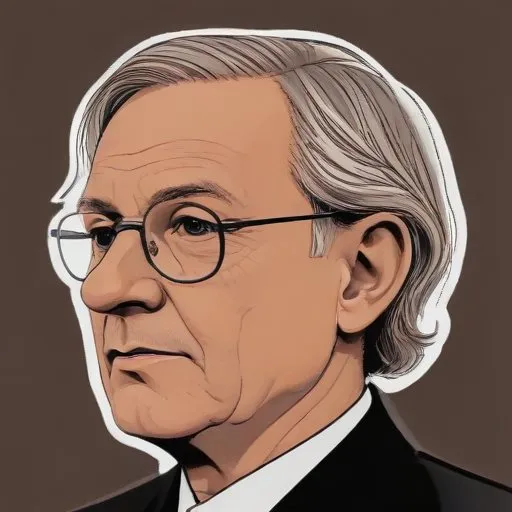
A renowned sociologist who coined the term "risk society" to describe modern societies' obsession with managing and mitigating risks, and is also known for his work on globalization and individualization.
Ulrich Beck, a renowned German sociologist, left an indelible mark on the world of social sciences with his groundbreaking concepts of "risk society" and "reflexive modernization." Through his prolific work, Beck challenged traditional sociological perspectives, advocating for a cosmopolitan approach that acknowledged the intricate interconnectedness of the modern world.
Beck's most significant contribution lies in his theory of "risk society," which posits that modern societies are increasingly defined by their ability to manage and navigate risk. This concept revolutionized the field of sociology, shifting the focus from industrial production and class conflicts to the management of uncertainty and risk. Beck's work emphasized that risks are no longer confined to specific territories or populations but have become global in nature, requiring a radical rethinking of how we approach social organization and governance.
Beck's idea of "reflexive modernization" built upon his risk society theory, arguing that modern societies are characterized by a perpetual state of self-reflection and critique. This concept challenged traditional notions of modernity, highlighting the need for societies to continuously reflect on and adapt to the consequences of their own actions. Beck's work encouraged a more nuanced understanding of modernity, recognizing the complex interplay between economy, politics, and culture.
Ulrich Beck was born on May 15, 1944, in Stolp, Germany (now Słupsk, Poland). Growing up in Hanover, Beck's intellectual curiosity was sparked at an early age, leading him to pursue higher education in law, sociology, philosophy, psychology, and political science at the University of Munich. His academic journey culminated in a doctorate, followed by a habilitation thesis, which earned him a professorship at the University of Munich.
Ulrich Beck's work has left an enduring impact on the field of sociology, influencing a generation of scholars and researchers. His ideas have transcended academic boundaries, shaping public discourse and policy-making in areas such as environmental governance, risk management, and global politics. Beck's cosmopolitan approach has inspired a new wave of researchers to adopt a more nuanced and contextual understanding of modern societies.
"The risk society is not a society of equality, but a society of uncertainty."
"Modernity is not an end state, but a process of continuous self-transformation."
From 1972 to 1992, Beck held various professorships at the universities of Münster and Bamberg. He was a professor of sociology and director of the Institute for Sociology at the University of Munich from 1992 until his passing in 2015.
Ulrich Beck's remarkable life and work have left an indelible mark on the world of sociology and beyond. His ideas continue to inspire and challenge scholars, policymakers, and citizens alike, ensuring that his legacy will endure for generations to come.
97 Years Old
A prominent thinker who developed the concept of "communicative action" and explored the relationships between power, language, and social structures, influencing modern critical theory and sociology.
Born in 1903
A critical theorist who critiqued modern society, culture, and capitalism, arguing that they perpetuate inequality and stifle individual freedom. His work influenced many fields, from sociology to musicology.
Born in 1898
A critical theorist who challenged traditional notions of freedom, democracy, and consumerism, arguing that modern society is oppressive and dehumanizing.
Born in 1895
A critical theorist who developed the concept of Critical Theory, which critiques modern capitalist society and advocates for social change. Known for his work on authoritarianism and the culture industry.
Born in 1885
A German philosopher who explored the concept of utopia and the human desire for a better world, influencing Marxist thought and critical theory.
Born in 1892
A German philosopher and critic who analyzed the impact of technology on society, particularly in regards to art and culture, and is famous for his concept of "aura" in the age of mechanical reproduction.
Born in 1897
Developed the concept of "civilizing process" to explain how human behavior and societal norms change over time, and is known for his work on the sociology of knowledge and the process of state formation.
Born in 1925
A renowned sociologist and philosopher who explored the human condition, morality, and the consequences of modernity, particularly in the context of globalization and consumerism.
