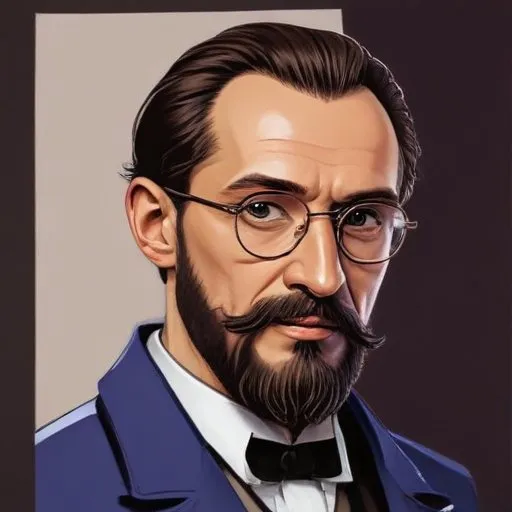
Leon Marchlewski

Leon Marchlewski

Leon Marchlewski was born on December 15th, 1869

Nationality: Polish
Profession: Chemist and academic
Field of study: Chemistry
Country of birth: Poland
Born in city: Śrem
Born on date: May 29, 1869
Died on date: February 16, 1946
Resting place: Powązki Cemetery

Developed the first comprehensive system of organic chemistry nomenclature, revolutionizing the field by creating a standardized language for chemists to communicate and classify compounds.

Leon Marchlewski, a renowned Polish chemist, was born on December 15, 1869, in Wocławek, Congress Poland, to Józef Marchlewski, a merchant, and Emilia née Rckersfeldt, a governess. He was destined for greatness, being the younger brother of Julian Marchlewski, a prominent communist activist.

Marchlewski's academic pursuits began in 1888 at the ETH Zurich, where he studied chemistry under the guidance of Professor Georg Lunge. He earned his doctoral degree in 1890 and subsequently became an assistant to Edward Schunck in Kersal, near Manchester. It was during this period that he collaborated with Marceli Nencki, a Polish physician and biochemist, on research focused on the chemical affinity of dyes in the animal and plant world. This collaboration laid the foundation for his groundbreaking work in chlorophyll chemistry.

Marchlewski's most significant contribution to the field of chemistry lies in his pioneering work on chlorophyll. His 1900 habilitation thesis, titled "Die Chemie des Chlorophylls," cemented his position as a leading authority in the field. His research shed light on the chemical structure and properties of chlorophyll, paving the way for subsequent breakthroughs in the field.

Throughout his illustrious career, Marchlewski held various prestigious positions. He served as a professor at the Jagiellonian University, where he also held the position of rector twice (1926-1927 and 1927-1928). Additionally, he was the head of the Institute of Medicinal Chemistry from 1906 to 1939. His dedication to the advancement of chemistry led to the establishment of the National Scientific Institute of Agricultural Economy in Puławy in 1917-1919.

Marchlewski's commitment to the development of chemistry in Poland is evident in his role as the first director of the Polish Chemical Society. He was also an honorary member of the society, a testament to his immense contributions to the field.

  • 1869: Born on December 15 in Wocławek, Congress Poland
  • 1888: Began studying chemistry at the ETH Zurich
  • 1890: Earned his doctoral degree
  • 1900: Returned to Poland and obtained his habilitation
  • 1906-1939: Head of the Institute of Medicinal Chemistry
  • 1917-1919: Established the National Scientific Institute of Agricultural Economy in Puławy
  • 1926-1927 and 1927-1928: Rector of the Jagiellonian University
  • 1946: Passed away on January 16

Marchlewski's pioneering work in chlorophyll chemistry and clinical chemistry has had a lasting impact on various fields, including medicine, agriculture, and environmental science. His contributions have paved the way for further research and discoveries, solidifying his position as a trailblazer in the history of chemistry.

Marchlewski's work can be compared to that of his contemporaries, such as Marceli Nencki and Edward Schunck, who also made significant contributions to the field of chemistry. However, Marchlewski's focus on chlorophyll chemistry and his establishment of the Polish Chemical Society set him apart as a pioneer in his field.

Marchlewski's life and work must be understood within the context of the late 19th and early 20th centuries, a time of rapid scientific progress and discovery. His contributions to chemistry have had a lasting impact on the field, and his legacy continues to inspire future generations of scientists and researchers.

Timeline
1869
Birth in Kraków, Poland
Leon Marchlewski was born on May 22, 1869, in Kraków, Poland (then part of the Austro-Hungarian Empire).
1894
Ph.D. in Chemistry from University of Kraków
Marchlewski earned his Ph.D. in chemistry from the University of Kraków, where he would later become a professor.
1903
Professor of Chemistry at University of Kraków
Marchlewski became a professor of chemistry at the University of Kraków, where he taught and conducted research.
1925
Death in Kraków, Poland
Leon Marchlewski passed away on January 16, 1925, in Kraków, Poland, at the age of 55.
1949
Honorary Doctorate from AGH University of Science and Technology
Marchlewski was posthumously awarded an honorary doctorate from the AGH University of Science and Technology in Kraków.
Leon Marchlewski

Leon Marchlewski Quiz

What is Leon Marchlewski known for developing in the field of organic chemistry?

Score: 0/5
FAQ
What were Leon Marchlewskis contributions to the field of chemistry?
Leon Marchlewski was a Polish chemist and academic who made significant contributions to the field of chemistry, particularly in the areas of organic chemistry and pharmaceuticals. He discovered several new compounds and developed new methods for the synthesis of pharmaceuticals.
What was Leon Marchlewskis role in the development of pharmaceuticals?
Leon Marchlewski played a key role in the development of pharmaceuticals, particularly in the area of synthetic chemistry. He developed new methods for the synthesis of pharmaceuticals and discovered several new compounds with important medicinal properties.
How did Leon Marchlewskis work impact the field of medicine?
Leon Marchlewskis work had a significant impact on the field of medicine, enabling the development of new treatments and therapies. His discoveries and innovations in synthetic chemistry helped to improve the lives of millions of people around the world.
What was Leon Marchlewskis approach to research and discovery?
Leon Marchlewski was known for his rigorous and systematic approach to research and discovery. He combined a deep understanding of chemical principles with a passion for experimentation and innovation.
What is Leon Marchlewskis legacy in the field of chemistry?
Leon Marchlewskis legacy in the field of chemistry is that of a pioneer and innovator. He is remembered as a leading figure in the development of pharmaceuticals and his contributions continue to have an impact on the field today.

Related People:

Marian Smoluchowski

Born in 1872

A pioneer in the field of statistical physics, he developed the theory of Brownian motion, providing strong evidence for the existence of atoms and molecules. His work laid the foundation for modern theories of particle motion.

Born in 1869

A Polish scholar and politician who served as President of the Republic of Poland, known for his brief but significant tenure during a tumultuous period in the country's history. He played a key role in shaping Poland's early 20th-century politics.

Born in 1867

A Polish leader who played a crucial role in regaining Poland's independence after World War I and served as the country's prime minister, known for his military prowess and statesmanship.

Born in 1882

A Polish mathematician and academic who made significant contributions to set theory, topology, and fractal geometry, particularly with the discovery of the Sierpinski triangle and carpet.