


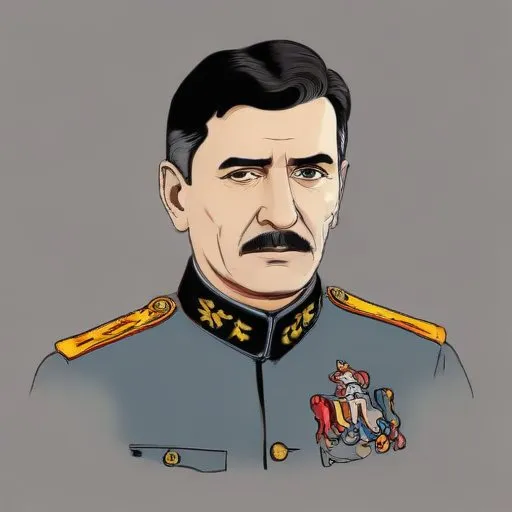
A Romanian general and politician who played a key role in World War II, serving as the Minister of Defense and leading the country's military efforts. He's also known for his involvement in the country's fascist movement.
Leonard Mociulschi is renowned for his bravery and tactical prowess as a Major General of Polish origin during World War II. As a skilled military leader, he played a crucial role in Romania's campaign, earning him numerous decorations and promotions throughout his illustrious career.
Born on March 27, 1889, in Siminicea, Botoani County (now in Suceava County), Mociulschi descended from Polish nobility that had been naturalized as Romanian citizens. His military career began with the 13th Regiment in Iași, where he started his training in 1910. Upon graduating from the Infantry Officers School in Bucharest in 1912, he was commissioned as a Second Lieutenant and assigned to the 8th Infantry Regiment in Botoani.
After the end of World War I, Mociulschi was promoted to major and later given command of a mountain battalion in Sighetu Marmației, with the rank of lieutenant-colonel. In 1937, he was promoted to colonel.
On February 10, 1941, Mociulschi was appointed deputy commander of the 1st Mountain Brigade, under the command of Brigadier General Mihail Lascăr and attached to the Romanian 3rd Army. On June 22, 1941, Romania joined Operation Barbarossa on the side of the Axis, and Mociulschi played a key role in the country's military campaign.
Leonard Mociulschi's military career spanned over four decades, during which he demonstrated exceptional leadership skills, bravery, and tactical acumen. His contributions to Romania's military campaign during World War II earned him a lasting legacy as a respected and decorated military leader.
Mociulschi passed away on April 15, 1979, leaving behind a legacy that continues to inspire future generations of military leaders and historians alike.
Born in 1874
A Romanian general and politician who served as Prime Minister of Romania, known for his role in the country's transition from monarchy to communism. He played a crucial part in the early years of communist Romania.
Born in 1873
Romanian lawyer and politician who served as the 32nd Prime Minister of Romania, known for his role in the country's interwar period and his efforts to maintain democracy. He was a key figure in the Romanian National Peasants' Party.
