


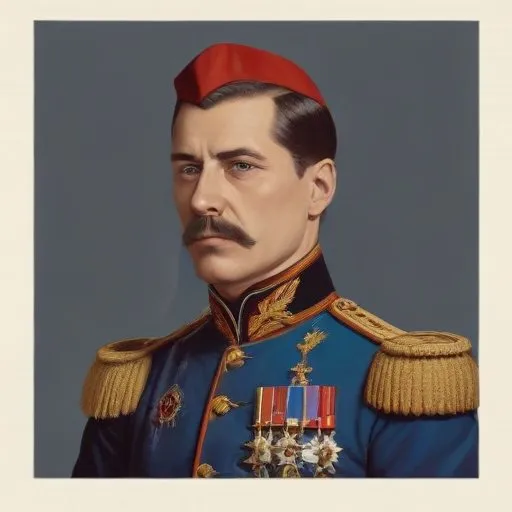
King of Romania from 1914 to 1927, ruling during World War I and unifying Transylvania, Banat, and other territories with Romania. He played a crucial role in shaping modern Romania's borders and identity.
Ferdinand I, nicknamed "the Unifier", is revered as the King of Romania who unified the country, expanding its territories and modernizing its society. He ruled from 1914 to 1927, leaving an indelible mark on Romania's history, earning him a prominent place in the country's pantheon of national heroes.
Born on August 24, 1865, Ferdinand Viktor Albert Meinrad was the second son of Leopold, Prince of Hohenzollern, and Infanta Antónia of Portugal. His family was part of the Catholic branch of the Prussian royal family, the Hohenzollerns. This prestigious lineage would eventually propel Ferdinand to the throne of Romania.
In 1889, Ferdinand became Crown Prince of Romania, following the renunciation of his father and older brother to the rights of succession. He would later marry Princess Marie of Edinburgh in 1893, granddaughter of both Queen Victoria and Emperor Alexander II. When King Carol I died in 1914, Ferdinand ascended to the throne, taking the name Ferdinand I.
During World War I, Ferdinand made the fateful decision to side with the Triple Entente against the Central Powers. This courageous stance earned him the ire of Kaiser Wilhelm II of Germany, who removed his name from the royal house of Hohenzollern. Despite this, Ferdinand's determination led to Romania's emergence as a victorious nation, gaining significant territories, including Bessarabia, Bukovina, and Transylvania.
In 1920, Ferdinand was crowned king of Greater Romania in a grand ceremony, marking the unification of the country. This milestone was preceded by a series of transformations in Romanian society, including the implementation of agrarian reform and universal suffrage. Ferdinand's vision for a modern, unified Romania had finally become a reality.
Ferdinand's personal life was marked by turmoil, particularly in his relationships with his eldest son, Prince Carol. In 1925, Prince Carol relinquished his rights to the throne, sparking a dynastic crisis. Ferdinand responded by removing Prince Carol's name from the royal house of Romania, paving the way for his 4-year-old grandson, Prince Michael, to ascend to the throne.
Ferdinand I's reign was marked by his unwavering commitment to unity, modernization, and the betterment of Romanian society. He worked tirelessly to promote education, social reform, and economic growth, earning him the respect and admiration of his people. Ferdinand's legacy continues to inspire Romanians to this day, cementing his place as one of the country's most revered monarchs.
Ferdinand I's remarkable life and reign serve as a testament to his unwavering dedication to Romania and its people. His unification of the country, bravery in World War I, and commitment to modernization have earned him a permanent place in Romania's history, inspiring generations to come.
Born in 1839
The first ruler of Romania, unifying the country and establishing its independence from the Ottoman Empire, known for modernizing and westernizing the nation.
Born in 1921
The last king of Romania, ruling from 1927 to 1930 and again from 1940 to 1947, known for his efforts to resist Soviet influence and his role in the country's transition to communism.
Born in 1868
The last emperor of Russia, ruling from 1894 to 1917, known for his poor leadership and decisions that led to the downfall of the Romanov dynasty and the rise of communism.
Born in 1762
The extravagant and flamboyant King of the United Kingdom, known for his lavish lifestyle, extravagant fashion sense, and architectural projects, including the transformation of Buckingham Palace. He played a significant role in the development of Regency London.
Born in 1820
Unified Italy's first king, who played a key role in the country's unification and modernization. He's remembered for his strong leadership and diplomatic skills.
Born in 1830
The longest-reigning ruler of Austria-Hungary, presiding over a vast empire that spanned across Central Europe, and remembered for his role in shaping European history through diplomacy and war.
Born in 1872
The first king of Norway after the country's independence from Sweden, he played a crucial role in maintaining Norway's sovereignty during World War II. He's revered for his bravery and leadership during the war.
Born in 1875
King of Belgium from 1909 to 1934, leading the country through World War I and its aftermath, earning him the nickname "The Hero King" for his bravery and leadership.
