


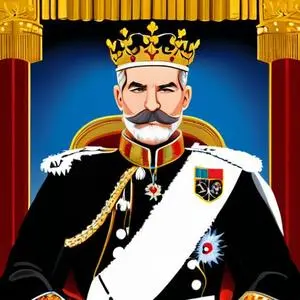
The longest-reigning ruler of Austria-Hungary, presiding over a vast empire that spanned across Central Europe, and remembered for his role in shaping European history through diplomacy and war.
Franz Joseph I, also known as Francis Joseph I, is renowned for his six-decade reign as Emperor of Austria, King of Hungary, and ruler of the Habsburg monarchy from 1848 to 1916. During his long and storied career, he navigated the tumultuous landscape of European politics, fostering a complex legacy that continues to influence modern society.
Born on August 18, 1830, in Schönbrunn Palace, Vienna, Franz Joseph was the nephew of Emperor Ferdinand I. Following the abdication of his uncle in December 1848, Franz Joseph ascended to the throne, marking the beginning of a remarkable reign that would shape the fate of the Habsburg empire.
In 1854, Franz Joseph married his cousin, Duchess Elisabeth in Bavaria, with whom he had four children: Sophie, Gisela, Rudolf, and Marie Valerie. This union produced a ripple effect of diplomatic alliances and familial connections that would critically impact European politics in the centuries to come.
Franz Joseph's early reign was marked by a strong resistance to constitutionalism in his domains. He ceded influence over Tuscany and Lombardy-Venetia to the Kingdom of Sardinia, following the Second and Third Italian Wars of Independence in 1859 and 1866, respectively. The Austrian Empire's defeat in the Austro-Prussian War led to the Peace of Prague in 1866, which settled the German Question in favor of Prussia.
In response to growing nationalist sentiments, Franz Joseph concluded the Austro-Hungarian Compromise of 1867, granting greater autonomy to Hungary and creating the dual monarchy of Austria-Hungary. This pivotal agreement established a delicate balance of power between the two nations, navigating the complex landscape of ethnic and linguistic diversity within the empire.
Franz Joseph's life was not without personal tragedy. His brother, Emperor Maximilian I of Mexico, was executed in 1867, and his son, Crown Prince Rudolf, died under mysterious circumstances in 1889. Despite these setbacks, Franz Joseph continued to rule wisely, maintaining a period of relative peace for the next 45 years.
Franz Joseph's reign coincided with a tumultuous period in European history, marked by wars, revolutions, and shifting alliances. His ability to balance competing interests and maintain stability within the empire earned him the respect of his contemporaries. Today, his legacy serves as a testament to the enduring power of imperial ambition and the complexities of modern nation-building.
In the context of his era, Franz Joseph's reign stands in stark contrast to that of his contemporaries, such as Napoleon III of France and Otto von Bismarck of Prussia. While they sought to expand their empires through aggressive military campaigns, Franz Joseph opted for a more nuanced approach, relying on diplomacy and strategic alliances to maintain his empire's integrity.
Franz Joseph's legacy extends far beyond the borders of the Austro-Hungarian Empire. His strategic decisions shaped the course of European politics, influencing the trajectory of world events in the 20th century. The echoes of his reign continue to resonate in modern society, as nations grapple with the challenges of globalization, nationalism, and regional integration.
Franz Joseph I of Austria remains an enigmatic figure, embodying the complexities of imperial ambition, nationalism, and the human experience. As we reflect on his remarkable life and reign, we are reminded of the enduring power of strategic leadership, diplomatic finesse, and the intricate web of relationships that shape the course of history.
Born in 1499
Reigned from 1559 to 1565, this Pope oversaw the final session of the Council of Trent, shaping Catholic doctrine and practice for centuries to come. He also commissioned the construction of the Sistine Chapel's dome.
