


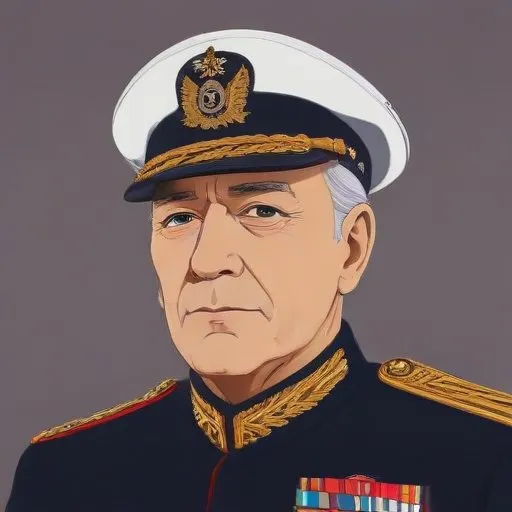
A Canadian naval officer who served as Commander-in-Chief of the Royal Canadian Navy during World War II, leading the country's naval forces to significant victories.
Leonard W. Murray, born on June 22, 1896, was a distinguished officer in the Royal Canadian Navy who rose to prominence during World War II. He is renowned for being the only Canadian to command an Allied theatre of operations during the war.
Murray's naval career began in 1913, when he entered service on the British armoured cruiser HMS Berwick. He served as a junior officer throughout World War I on Canadian and British ships, witnessing the surrender of the German fleet at Scapa Flow. Between the wars, he steadily rose through the ranks, serving on British ships and studying at the Royal Naval Staff College in the United Kingdom.
In 1939, Murray commanded the Canadian destroyer HMCS Saguenay, solidifying his reputation as a capable and strategic leader. He also commanded naval bases on Canada's east and west coasts, demonstrating his ability to adapt to different environments and responsibilities.
In 1940, Murray commenced his World War II service as Deputy Chief of Naval Staff, playing a crucial role in negotiations with the United States and the UK on rapidly expanding the Canadian Navy. He was a founding member of the Permanent Joint Board on Defence and helped negotiate the destroyers-for-bases deal.
In late 1940, Murray was reassigned to command positions on Canada's east coast, initially as commander of the Newfoundland Escort Force, and later as Commanding Officer Atlantic Coast. Following the Atlantic Convoy Conference of March 1943, Murray was appointed Commander-in-Chief, Canadian Northwest Atlantic, leading Canadian, British, American, and other Allied naval and air forces to victory in the Battle of the Atlantic.
Murray's decision to allow sailors to take shore leave in Halifax, Nova Scotia, on VE Day is believed to have contributed to the Halifax Riot of May 7, 1945. Although this incident marred his otherwise distinguished career, Murray's contributions to the Allied victory in the Battle of the Atlantic remain unparalleled.
Murray was awarded the Companion of the Order of the Bath (CB) and the Commander of the Order of the British Empire (CBE) for his exceptional service during World War II. His legacy as a decorated commander and leader continues to inspire generations of naval officers and historians alike.
Following his retirement from the Royal Canadian Navy, Murray relocated to the UK, where he spent his later years. He passed away on November 25, 1971, leaving behind a legacy of courage, strategic leadership, and unwavering dedication to his country and the Allied forces.
Born in 1896
A Canadian naval officer who served as Commander-in-Chief of the Royal Canadian Navy during World War II, leading the country's naval forces to significant victories.
95 Years Old
A country music legend, known as "The Possum," renowned for his smooth, baritone voice and iconic hits like "He Stopped Loving Her Today" and "White Lightning."
