


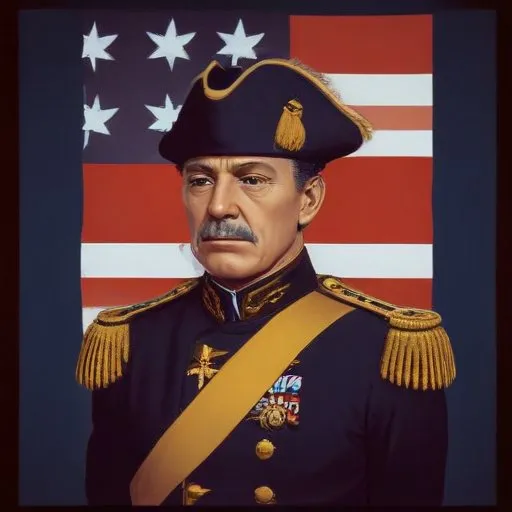
A Confederate general who led a brigade in Pickett's Charge during the Battle of Gettysburg, known for his bravery and sacrifice in a pivotal Civil War battle.
Lewis Armistead is best known for his pivotal role in Pickett's Charge during the Battle of Gettysburg, the largest and bloodiest battle of the American Civil War. On July 3, 1863, Armistead led his brigade to the farthest point reached by Confederate forces during the charge, a point now referred to as the high water mark of the Confederacy.
Born on February 18, 1817, in New Bern, North Carolina, Armistead came from an esteemed military family. His father, Walker Keith Armistead, was one of five brothers who fought in the War of 1812, and his uncle, Major George Armistead, was the commander of Fort McHenry during the battle that inspired Francis Scott Key to write "The Star-Spangled Banner."
Armistead attended the United States Military Academy, joining in 1833, but resigned the same year. He rejoined in 1834 but was found deficient and had to repeat his class. In 1836, he resigned again following an incident in which he broke a plate over the head of fellow cadet and future Confederate general Jubal Early. He was also struggling academically, particularly in French, a subject that proved challenging for many West Point cadets of that era.
Despite his tumultuous start, Armistead went on to have a successful military career. He served in the United States Army during the Mexican-American War and later became a brigadier general in the Confederate States Army during the American Civil War.
Armistead's brigade was part of General George Pickett's division, which was tasked with leading the charge against the Union center on Cemetery Ridge during the Battle of Gettysburg. On July 3, 1863, Armistead led his men in a fierce assault, but they were ultimately repelled by the Union troops. Armistead was wounded in the battle and captured by Union forces.
Lewis Armistead's bravery and leadership during Pickett's Charge have become the stuff of legend. His actions on that fateful day have been immortalized in history books and have come to symbolize the high water mark of the Confederacy.
Although Armistead's military career was cut short by his death on July 5, 1863, his legacy lives on. He is remembered as a courageous and determined leader who fought valiantly for the cause he believed in.
Armistead was known to his friends as "Lo" or "Lothario," and was described as being charming and affable. He came from a long line of English ancestors who had settled in Virginia in the early 1600s.
Through his mother's side, Armistead was related to several prominent figures, including his grandfather, John Stanly, who was a U.S. Congressman, and his uncle, Edward Stanly, who served as military governor of eastern North Carolina during the Civil War.
Lewis Armistead's story serves as a testament to the bravery and sacrifice of those who fought on both sides of the American Civil War. His legacy continues to inspire and captivate historians and enthusiasts alike, and his name will forever be etched in the annals of American history.
Born in 1807
Led the Confederate States Army during the American Civil War, surrendering to Union forces at Appomattox, marking the war's effective end.
Born in 1822
Led the Union Army to victory in the Civil War and later became President, known for issuing the Emancipation Proclamation and strengthening federal authority.
Born in 1821
A Confederate general during the American Civil War, later serving as a diplomat and ambassador to Turkey, known for his military strategies and post-war reconciliation efforts.
Born in 1826
A Union general during the American Civil War, he's infamous for his cautious tactics and disagreements with President Lincoln, later becoming a governor of New Jersey.
Born in 1820
A renowned Union general during the American Civil War, he's infamous for his scorched earth tactics and march through the Confederacy, leaving destruction in his wake.
Born in 1824
A prominent Union general during the American Civil War, known for his heroic actions at Gettysburg, and later a presidential candidate.
