


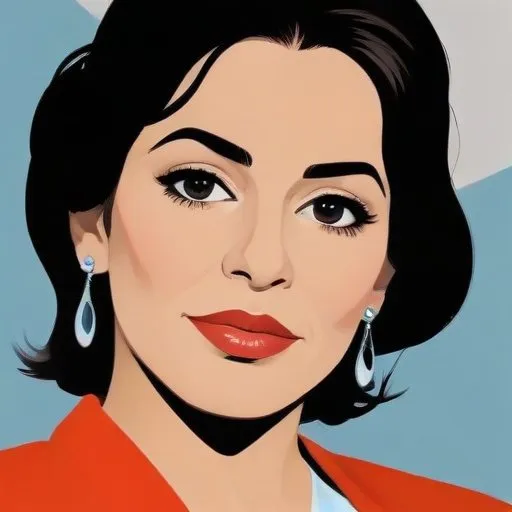
A legendary actress and singer who dominated Argentine cinema and music for decades, known for her iconic film roles and powerful vocals.
Known as "La Novia de América" (America's Sweetheart), Libertad Lamarque was a legendary Argentine actress and singer who left an indelible mark on the Golden Age of Argentine and Mexican cinema. With a career spanning over seven decades, she appeared in 65 films, recorded over 800 songs, and made countless theatrical appearances, cementing her status as a cultural treasure in Latin America.
Libertad Lamarque was born on November 24, 1908, in Rosario, Santa Fe Province, Argentina, to Gaudencio Lamarque, an Uruguayan of French descent, and Josefa Bouza, a widow of Spanish origin. Her father, an anarchist, was imprisoned at the time of her birth, and she was named Libertad (Liberty) in a plea for his release.
At the tender age of 7, Lamarque won first prize in a stage competition, and soon began performing with a group of street singers, touring nearby cities. In 1923, she made her professional debut in the stage show "Madre Tierra," which convinced her parents to relocate to Buenos Aires to further her career.
In 1926, Lamarque was hired to sing in the choir at the National Theatre, where she made her debut in the play "La muchacha de Montmartre" (The Girl from Montmartre). Her talent soon led to her signing with Victor Records, releasing her first album, "Gaucho Sol," and single, "Chilenito," in 1926.
By the late 1920s, Lamarque had become a household name, with her face plastered on billboards and her voice echoing on radios across the continent. Her early success led to her being hailed as "La Novia de América," a title that would stick with her throughout her illustrious career.
Lamarque's film career took off in the 1930s, with her starring in classic Argentine films such as "Tango" (1933) and "Puerto Nuevo" (1936). Her move to Mexico in the 1940s led to even greater success, with films like "Gran Hotel" (1944) and "Historia de una Escalera" (1950), cementing her status as a queen of Mexican cinema.
In the 1950s and 1960s, Lamarque continued to act in films, such as "La Casa de las Siete Chimeneas" (1953) and "El Derecho de nacer" (1966), showcasing her range and versatility as an actress.
Libertad Lamarque's legacy extends far beyond her impressive body of work. She was a trailblazer for women in the entertainment industry, paving the way for future generations of Latin American actresses. Her music and films continue to be celebrated and cherished, inspiring new generations of artists and audiences alike.
Lamarque's impact on Latin American popular culture is immeasurable. She was a true icon, whose talent, beauty, and charisma captivated audiences across the continent. Her legacy continues to inspire, with her music and films remaining an integral part of Latin American cultural heritage.
Libertad Lamarque passed away on December 12, 2000, leaving behind a rich legacy that continues to inspire and delight audiences across Latin America and beyond.
Born in 1919
A former actress who used her charisma and influence to advocate for women's suffrage and workers' rights, becoming a beloved and powerful figure in Argentine politics.
Born in 1895
The authoritarian leader who ruled Argentina with his charismatic wife Eva, implementing populist economic policies and promoting nationalism, while suppressing opposition and civil liberties.
Born in 1890
A legendary tango singer-songwriter and actor, known for his smooth, baritone voice and iconic songs that captured the essence of Argentine culture. He's often referred to as the "King of Tango".
Born in 1920
A talented actress who shone brightly in Argentine cinema, starring in over 40 films and earning numerous awards for her captivating performances.
