


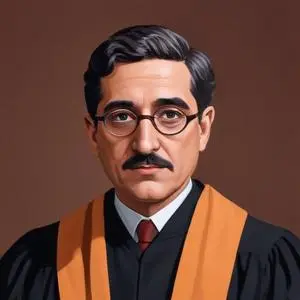
A pioneering lawyer and jurist who championed individual rights and freedoms, shaping the course of American law and democracy through landmark Supreme Court decisions.
Louis Brandeis, a renowned American lawyer and jurist, is best known for his pioneering work in developing the concept of the right to privacy and his tireless advocacy for social justice, earning him the epithet "The People's Lawyer." Throughout his illustrious career, Brandeis played a crucial role in shaping the nation's legal landscape, leaving an indelible mark on American history.
Born on November 13, 1856, in Louisville, Kentucky, Brandeis was the youngest of four children to Adolph Brandeis and Frederika Dembitz. Raised in a culturally rich and intellectually stimulating environment, Brandeis developed a strong passion for learning, which led him to pursue higher education at Harvard Law School. He graduated in 1877, ranking highest in his class.
In 1890, Brandeis wrote a seminal article, "The Right to Privacy," which was published in the Harvard Law Review. This groundbreaking work introduced the concept of privacy as a fundamental right, significantly expanding the scope of individual liberties. His subsequent involvement in the antitrust movement, particularly in his resistance to the monopolization of the New England railroad, solidified his reputation as a champion of social justice.
Brandeis was a vocal critic of the concentration of corporate power, monopolies, and the corrupting influence of money on politics. Through his writings, including "Other People's Money and How the Bankers Use It" and "The Curse of Bigness," he alerted the public to the dangers of unchecked capitalism and the erosion of American values. His work inspired a generation of reformers and policymakers to reexamine the role of government in regulating business and protecting the public interest.
In the early 20th century, Brandeis became deeply involved in the Zionist movement, seeing it as a means to combat anti-Semitism in Europe and Russia, as well as to revitalize the Jewish spirit. This commitment led him to advocate for the creation of a Jewish homeland in Palestine. Throughout his life, Brandeis remained dedicated to various social causes, earning him the respect and admiration of his contemporaries.
In 1916, President Woodrow Wilson nominated Brandeis to the Supreme Court of the United States, making him the first Jewish justice in American history. During his 23-year tenure, Brandeis wrote several landmark opinions, shaping the court's approach to civil liberties, labor rights, and business regulation. His legacy extends beyond the legal sphere, as his commitment to social justice and individual rights continues to inspire generations of Americans.
Brandeis's philosophical outlook was shaped by his commitment to individual rights, social justice, and democratic values. He believed that the primary purpose of government was to protect the interests of the people, not to serve the interests of the powerful. This conviction guided his work as a lawyer, writer, and jurist, as he consistently challenged the concentration of power and advocated for the rights of the marginalized.
Louis Brandeis's impact on American society is multifaceted and profound. His work on the right to privacy has shaped the country's legal framework, while his critique of corporate power and consumerism continues to resonate with contemporary debates on inequality and social justice. As a champion of social reform and individual rights, Brandeis's legacy serves as a beacon of hope for those striving to create a more just and equitable society.
Born in 1858
A pioneering leader who championed progressive reforms, trust-busting, and conservation, earning a Nobel Peace Prize for mediating the Russo-Japanese War. He's also famous for his rugged outdoorsmanship and "big stick" diplomacy.
Born in 1856
The 28th President of the United States, a Nobel Peace Prize winner, and a historian who played a key role in shaping international relations and global governance after World War I. He's most known for his idealistic vision of a League of Nations and his efforts to promote peace and diplomacy.
Born in 1882
Led the United States through the Great Depression and World War II, implementing a series of reforms known as the New Deal and helping to establish the country as a global superpower.
Born in 1872
The 12th Chief Justice of the United States, a prominent lawyer and jurist, is most known for his significant contributions to shaping the Supreme Court's decisions and upholding the Constitution. He played a crucial role in establishing the Court's liberal wing during the New Deal era.
Born in 1862
A prominent lawyer and politician who served as the 44th Secretary of State, known for his influential decisions and diplomatic efforts in shaping international relations. He played a key role in resolving the Mexican Revolution crisis.
66 Years Old
Associate Justice of the Supreme Court of the United States, serving since 2010 and known for her liberal stance and influential opinions on key cases. She is the fourth woman to serve on the Court.
93 Years Old
A pioneering Supreme Court Justice and women's rights advocate who championed gender equality and became a cultural icon.
88 Years Old
An Associate Justice of the Supreme Court, known for interpreting the US Constitution and shaping the country's laws and policies through landmark decisions. A prominent figure in American jurisprudence, influencing the nation's social and political landscape.
