


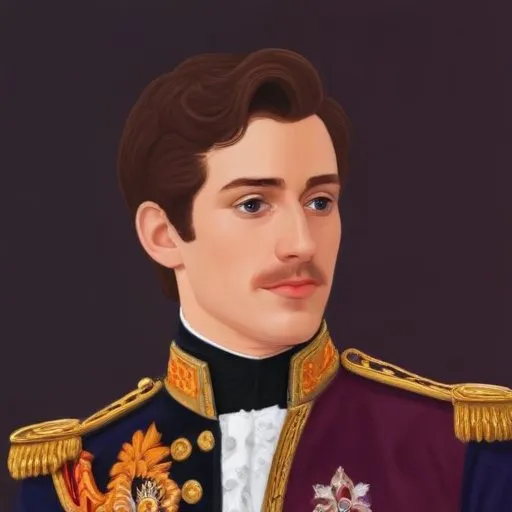
The last heir of the French monarchy, known for his tragic fate as a child prisoner during the French Revolution. He was the son of King Louis XVI and Queen Marie Antoinette.
Louis Charles Alphonse Léodgard d'Orléans, Count of Beaujolais, was a French prince of the blood, born on October 7, 1779, in Paris. As the youngest son of Philippe Égalité, Duke of Orléans, and Louise Marie Adélaïde de Bourbon, he was a member of the reigning House of Bourbon, making him a prince du sang.
Louis Charles was born at the Palais-Royal in Paris, and his early life was marked by luxury and privilege. His mother, Louise Marie Adélaïde de Bourbon, was the greatest heiress of her time, and her vast wealth and influence shaped Louis Charles' upbringing. In 1781, the Countess of Genlis was appointed as his governess, along with his two older brothers, Louis Philippe and Antoine. Later, the Abbé Mariottini, nephew of the apostolic nuncio to France, became his tutor, but he resigned in 1786 due to conflicts with Madame de Genlis.
In April 1793, Louis Charles was arrested, along with his father, and imprisoned at Fort-Saint-Jean in Marseille. During his imprisonment, he contracted tuberculosis, a condition that eventually led to his death. His father, Philippe Égalité, was executed in November 1793, but Louis Charles remained imprisoned until August 1796, when the Directory decided to exile him and his brother Antoine to Philadelphia.
In Philadelphia, Louis Charles and Antoine were joined by their older brother Louis Philippe in February 1797. Together, they traveled to New York City, Boston, and as far north as Maine and as far south as Nashville. In September 1797, they learned that their mother had gone into exile in Spain, and they decided to return to Europe.
Louis Charles died on May 30, 1808, at the age of 28, due to complications from tuberculosis. His life was marked by tragedy, from his imprisonment and exile to his early death. Despite his short life, Louis Charles left a lasting legacy as a member of the French royal family and a prince du sang.
Louis Charles lived during a tumultuous time in French history, marked by the French Revolution and the fall of the monarchy. Despite his tragic life, Louis Charles played an important role in the history of the French royal family, and his legacy continues to be felt today.
Born in 1462
The king who ruled France from 1498 to 1515, known for his military campaigns in Italy and his role in the Italian Wars, which shaped the country's foreign policy.
Born in 1755
The last queen of France before the French Revolution, known for her extravagance and mismanagement of the French economy, which contributed to the downfall of the monarchy.
Born in 1643
A 17th-century nobleman who ruled Lorraine and played a significant role in the Thirty Years' War, known for his military campaigns and territorial expansions.
Born in 1691
A German nobleman who ruled Hesse-Darmstadt from 1739 to 1768, known for his military campaigns and territorial expansions.
Born in 1769
A French military leader who rose to prominence during the French Revolution and became Emperor of France, known for his military conquests and reorganization of Europe. He is also famous for his Napoleonic Code, which remains a foundation of modern law.
