


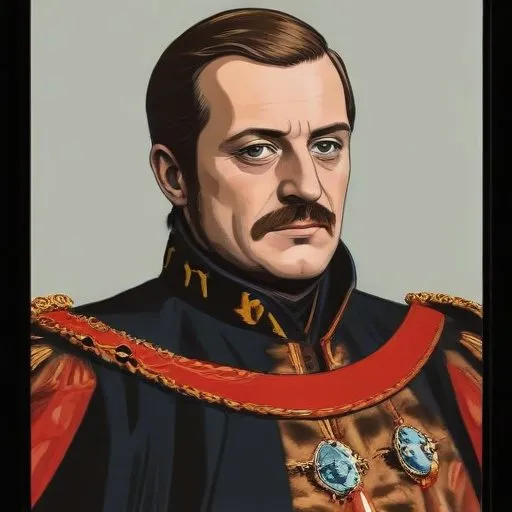
Ruler of Hesse from 1877 to 1892, known for his marriage to Princess Alice, Queen Victoria's daughter, and his role in the unification of Germany.
On July 1, 1862, Louis married Princess Alice at Osborne House on the Isle of Wight. This arranged marriage, orchestrated by Queen Victoria and Prince Albert, surprisingly led to a brief period of courtship before the betrothal. Although the couple's union was initially orchestrated, they did eventually develop a strong bond, reflected in their decision to wed willingly despite Queen Victoria's protracted state of grief following Prince Albert's death.
With Princess Alice's interests in social services and scientific development, the couple's financial struggles were further exacerbated. They became parents in less than a year following their marriage, adding to their financial burdens. Despite these challenges, the couple's strong bond and commitment to their duties as members of royalty remained unwavering.
Louis IV's legacy extends beyond his personal connections to the British royal family. His commitment to his duties as Grand Duke and his support for his wife's charitable endeavors left a lasting impact on the people of Hesse and by Rhine. His story serves as a testament to the complexities and challenges faced by European royalty in the 19th century.
Louis IV's life and reign were marked by significant historical events, including the Franco-Prussian War and the unification of Germany. His connection to the British royal family and his role as Grand Duke of Hesse and by Rhine placed him at the center of European politics and royalty. His legacy serves as a testament to the complexities of royal life in the 19th century, marked by a delicate balance of power, duty, and personal relationships.
Born in 1840
The eldest child of Queen Victoria and Prince Albert, she was a pioneering figure in British-German relations and a devoted wife and mother, known for her strong character and diplomatic skills.
Born in 1831
The last German Emperor and King of Prussia, ruling for just 99 days, he's known for his liberal reforms and being the father of Wilhelm II, who led Germany into World War I.
Born in 1859
The last German Emperor and King of Prussia, ruling from 1888 to 1918, known for his aggressive foreign policy and militarism that contributed to the outbreak of World War I. He was also known for his eccentric and impulsive behavior.
Born in 1819
The monarch who ruled the British Empire for 63 years, overseeing the Industrial Revolution and expanding the empire's reach, earning the nickname "the Grandmother of Europe".
Born in 1868
The last grand duke of Hesse and by Rhine, he ruled from 1892 to 1918 and was a patron of the arts, supporting artists like Wassily Kandinsky and Ludwig Kirchner. He's also known for his marriage to Victoria Melita of Saxe-Coburg and Gotha, a granddaughter of Queen Victoria.
