


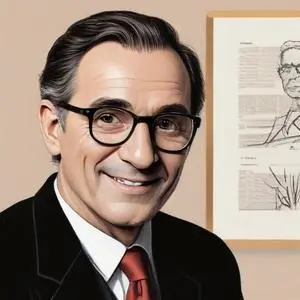
A pharmacologist and academic who discovered the role of nitric oxide in the cardiovascular system, leading to breakthroughs in heart disease treatment.
Louis Ignarro is a trailblazing American pharmacologist renowned for his groundbreaking research on the signaling properties of nitric oxide, earning him the 1998 Nobel Prize in Physiology or Medicine. This pioneering work revolutionized our understanding of cardiovascular health, and his discoveries paved the way for the development of Viagra.
Ignarro's academic journey began with a Bachelor of Science in Pharmacy from Columbia University in 1962, followed by a Ph.D. in Pharmacology from the University of Minnesota School of Medicine in 1966. A postdoctoral fellowship in chemical pharmacology from the National Institutes of Health in 1968 further solidified his foundation in the field.
Ignarro's illustrious academic career spans over four decades, with tenure at esteemed institutions such as Tulane University School of Medicine and the University of California, Los Angeles (UCLA). At UCLA, he served as a professor of pharmacology and is currently professor emeritus. His prolific research has yielded numerous publications, and in 1998, he received the Basic Research Prize from the American Heart Association.
Ignarro's most significant contribution to science lies in his discovery of nitric oxide's role as a signaling molecule in the cardiovascular system. This finding has far-reaching implications for the treatment of cardiovascular diseases, and his work has inspired new avenues of research in the field.
Ignarro is the founder of the Nitric Oxide Society, a non-profit organization dedicated to promoting research and education on nitric oxide. He also founded and serves as editor-in-chief of the scientific journal Nitric Oxide Biology and Chemistry.
Beyond his academic pursuits, Ignarro is committed to giving back to the community. He serves on the Board of Directors for Operation USA, a non-profit organization focused on disaster relief and humanitarian aid.
Louis Ignarro's work has left an indelible mark on the scientific community, paving the way for further research into the mysteries of nitric oxide. His legacy continues to inspire new generations of researchers, and his contributions to cardiovascular health have improved lives worldwide.
Born in 1916
Discovered the role of nitric oxide in the body, leading to breakthroughs in treatments for heart disease, stroke, and cancer. Known for his pioneering work in pharmacology and physiology.
90 Years Old
A renowned physician and pharmacologist who discovered the role of nitric oxide in the body, leading to breakthroughs in cardiovascular health and earning a Nobel Prize.
97 Years Old
A pioneering neuroscientist and psychiatrist who unraveled the mysteries of memory and learning, earning a Nobel Prize for his groundbreaking work on the physiological basis of memory storage.
Born in 1923
A Swedish pharmacologist and physician who discovered the neurotransmitter dopamine's role in the brain, leading to major breakthroughs in Parkinson's disease treatment.
Born in 1925
A pioneering neuroscientist who uncovered the molecular and cellular mechanisms underlying learning and memory, earning a Nobel Prize in Physiology or Medicine in 2000.
Born in 1909
A pioneering neuroscientist who discovered the growth factor NGF, revolutionizing our understanding of cell growth and development, and leading to major breakthroughs in cancer and neurodegenerative disease research.
Born in 1922
A Nobel Prize-winning biochemist who discovered epidermal growth factor, a protein essential for cell growth and development, and pioneered the field of growth factor research.
