


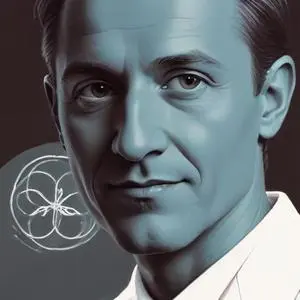
A Swedish pharmacologist and physician who discovered the neurotransmitter dopamine's role in the brain, leading to major breakthroughs in Parkinson's disease treatment.
Arvid Carlsson, a Swedish neuropharmacologist, is renowned for his groundbreaking work on the neurotransmitter dopamine and its effects on Parkinson's disease. His pioneering research earned him the Nobel Prize in Physiology or Medicine in 2000, alongside Eric Kandel and Paul Greengard.
Born on January 25, 1923, in Uppsala, Sweden, Carlsson was the third of four siblings. His family relocated to Lund after his father became a history professor at Lund University. Unlike his older siblings, who followed in their father's footsteps, Carlsson pursued a career in medicine, enrolling at Lund University in 1941.
In 1944, Carlsson participated in a pivotal task, examining prisoners of Nazi concentration camps who were brought to Sweden by Swedish aristocrat Folke Bernadotte. This experience had a profound impact on Carlsson, shaping his future research focus.
In 1957, Katharine Montagu demonstrated the presence of dopamine in the human brain. Carlsson, inspired by this discovery, went on to demonstrate that dopamine was a neurotransmitter in the brain and not just a precursor for norepinephrine. He developed a method for measuring dopamine levels in brain tissues and found that dopamine levels in the basal ganglia, a brain area crucial for movement, were particularly high.
Carlsson's research took a significant leap forward when he administered the drug reserpine to animals, causing a decrease in dopamine levels and a loss of movement control, similar to the symptoms of Parkinson's disease. By administering L-DOPA, the precursor to dopamine, he was able to restore movement control in these animals.
Arvid Carlsson's work has had a profound impact on our understanding of Parkinson's disease and the role of dopamine in the brain. His research has paved the way for the development of new treatments and has inspired future generations of neuropharmacologists.
Through his groundbreaking research, Carlsson has left an indelible mark on the scientific community, and his work continues to inspire and inform our understanding of the human brain.
96 Years Old
A pioneering neuroscientist and psychiatrist who unraveled the mysteries of memory and learning, earning a Nobel Prize for his groundbreaking work on the physiological basis of memory storage.
79 Years Old
A pioneering scientist who discovered the genes responsible for our sense of smell, leading to a deeper understanding of the human olfactory system. Her groundbreaking work has far-reaching implications for fields like neuroscience and medicine.
79 Years Old
Discovered the molecular mechanism of transcription, a crucial process by which cells read genetic information, and was awarded the Nobel Prize in Chemistry in 2006 for this groundbreaking work.
78 Years Old
A Nobel Prize-winning chemist and academic who discovered catalytic properties of RNA, revolutionizing our understanding of molecular biology.
75 Years Old
Australian physician and academic who discovered the bacterium Helicobacter pylori and its role in gastritis and peptic ulcer disease, revolutionizing the understanding and treatment of stomach ulcers.
Born in 1920
A French biologist and geneticist who discovered the mechanism of gene regulation, pioneering the field of molecular biology. He won the Nobel Prize in Physiology or Medicine in 1965 for his work on the genetic control of enzyme synthesis.
