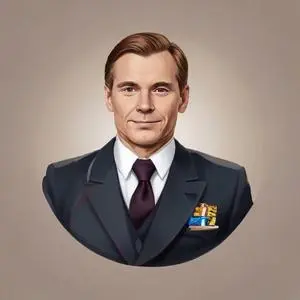
Folke Bernadotte: The Swedish Diplomat Who Saved Thousands of Lives
A Hero of World War II and Beyond
Folke Bernadotte, a Swedish nobleman and diplomat, is best known for his courageous efforts in rescuing approximately 450 Danish Jews and 30,550 non-Jewish prisoners from the Nazi German Theresienstadt concentration camp in 1945. As the Vice Chairman of the Swedish Red Cross, Bernadotte negotiated with
Heinrich Himmler, the notorious Nazi leader, to secure the release of these prisoners, earning him international recognition and acclaim.
Early Life and Royal Connections
Born on January 2, 1895, in Stockholm, Sweden, Folke Bernadotte was a member of the Swedish royal family, the House of Bernadotte. His father, Prince Oscar Bernadotte, Count of Wisborg, was the second son of King
Oscar II of Sweden, and his mother, Ebba Munck af Fulkila, was a lady-in-waiting to
Victoria of Baden, the wife of Crown Prince Gustaf.
Military and Diplomatic Career
Bernadotte attended the Royal Military Academy and later became a cavalry officer, serving as a lieutenant in 1918 and eventually rising to the rank of major. He represented Sweden at the 1933 Chicago Century of Progress Exposition and served as the Swedish commissioner general at the 1939-1940 New York World's Fair.
Humanitarian Work and the Red Cross
Bernadotte's most notable achievement was his work with the Swedish Red Cross during World War II. As the Vice Chairman, he traveled to Germany in 1945 to negotiate the release of prisoners from concentration camps. His efforts culminated in the rescue of thousands of lives, including those of Danish Jews and prisoners from various nations.
United Nations Mediator and Assassination
After the war, Bernadotte was unanimously chosen as the United Nations Security Council mediator in the Arab-Israeli conflict in 1947-1948. Tragically, he was assassinated in Jerusalem on September 17, 1948, by the paramilitary Zionist group Lehi while pursuing his official duties.
Legacy and Impact
Folke Bernadotte's selfless efforts and bravery have inspired generations. Upon his death,
Ralph Bunche took up his work at the United Nations, successfully mediating the 1949 Armistice Agreements between Israel and Egypt. Bernadotte's humanitarian work and legacy continue to serve as a beacon of hope and inspiration in the face of conflict and adversity.
Personal Milestones and Key Life Events
- Born on January 2, 1895, in Stockholm, Sweden
- Attended the Royal Military Academy and became a cavalry officer
- Represented Sweden at the 1933 Chicago Century of Progress Exposition
- Served as the Swedish commissioner general at the 1939-1940 New York World's Fair
- Rescued approximately 450 Danish Jews and 30,550 non-Jewish prisoners from Theresienstadt concentration camp in 1945
- Assassinated on September 17, 1948, in Jerusalem while serving as the United Nations Security Council mediator
Quotes and Memorable Sayings
- "The duty of the Red Cross is to alleviate human suffering, wherever it may be found."
- "In times of war, it is the duty of neutral countries to help those in need, without taking sides."
Historical Context and Legacy
Folke Bernadotte's remarkable life and humanitarian work serve as a testament to the power of courage, compassion, and diplomacy in the face of adversity. His selfless efforts have inspired generations, and his legacy continues to influence international diplomacy and humanitarian efforts to this day.
FAQ
What was Folke Bernadottes role in international diplomacy?
Folke Bernadotte was a Swedish diplomat who played a key role in international diplomacy, particularly in the Middle East. He was known for his mediation skills and helped to resolve several high-profile conflicts, including the 1948 Arab-Israeli War.
How did Folke Bernadottes experiences in World War II shape his diplomatic career?
Folke Bernadottes experiences in World War II, including his role in rescuing concentration camp prisoners, had a profound impact on his diplomatic career. He became dedicated to promoting peace and international cooperation in the face of conflict and war.
What were Folke Bernadottes views on the Israeli-Palestinian conflict?
Folke Bernadotte believed in the importance of finding a peaceful resolution to the Israeli-Palestinian conflict. He advocated for a two-state solution and worked to promote dialogue and cooperation between the parties, despite facing significant challenges and opposition.
How did Folke Bernadottes leadership style impact his diplomatic efforts?
Folke Bernadottes leadership style was marked by his commitment to impartiality, his ability to build trust with parties in conflict, and his willingness to take calculated risks to achieve peace. He was known for his creative and innovative approaches to conflict resolution.
What is Folke Bernadottes legacy in international diplomacy?
Folke Bernadottes legacy in international diplomacy is marked by his commitment to peace, his mediation skills, and his tireless efforts to resolve conflicts. He is remembered as a hero of international diplomacy and an inspiration to future generations of diplomats and mediators.