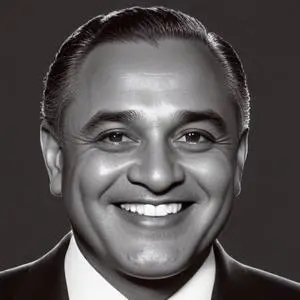
The Pioneering Diplomat: Ralph Bunche
Ralph Bunche, a renowned American political scientist and diplomat, is best known for his instrumental role in the mid-20th century decolonization process and US civil rights movement. In 1950, he became the first black Nobel laureate and the first person of African descent to be awarded a Nobel Prize, specifically the Nobel Peace Prize, for his remarkable mediation in Israel during the late 1940s.
Early Life and Education
Born on August 7, 1904, in Detroit, Michigan, Bunche grew up in Los Angeles, California. He earned his Bachelor's degree in Political Science from the University of California, Los Angeles (UCLA) in 1927, and later pursued his Master's and Ph.D. in Political Science from Harvard University.
Career Highlights
- United Nations Career: Bunche played a pivotal role in the formation and early administration of the United Nations. He served on the US delegation to the Dumbarton Oaks Conference in 1944 and the United Nations Conference on International Organization in 1945, which drafted the UN charter.
- Middle East Mediation: In 1948, Bunche became an acting mediator for the Middle East, successfully negotiating an armistice between Egypt and Israel, earning him the Nobel Peace Prize in 1950.
- UN Troubleshooter: Throughout his UN career, Bunche held various troubleshooting roles, addressing crises in the Sinai (1956), Congo (1960), Yemen (1963), Cyprus (1964), and Bahrain (1970). He reported directly to the UN Secretary-General and chaired study groups dealing with water resources in the Middle East.
- Under-Secretary-General: In 1957, Bunche was promoted to Under-Secretary-General for special political affairs, overseeing peacekeeping roles. He supervised the ceasefire following the war between India and Pakistan in 1965.
Awards and Honors
In addition to the Nobel Peace Prize, Bunche received the Presidential Medal of Freedom in 1963, awarded by President John F. Kennedy.
Legacy
Ralph Bunche's remarkable contributions to international diplomacy and peacekeeping have left a lasting impact on modern society. He is remembered as a pioneering figure in the decolonization process, a champion of civil rights, and a testament to the power of dedication and perseverance.
Personal Milestones
Bunche retired from the UN in June 1971, passing away on December 9, 1971. Despite his passing, his legacy continues to inspire future generations of diplomats, politicians, and civil rights activists.
Philosophical Contributions
Bunche's work embodied the importance of diplomacy, negotiation, and cooperation in resolving international conflicts. His commitment to peaceful resolution and decolonization has inspired a new wave of diplomats and policymakers.
Historical Context
Bunche's life and work spanned a pivotal period in world history, marked by decolonization, civil rights movements, and the emergence of the United Nations as a global institution. His contributions to this era have solidified his place as one of the most influential figures of the 20th century.
FAQ
What was Ralph Bunches role in the United Nations?
Ralph Bunche was a leading figure in the United Nations, serving as the Under-Secretary-General for Special Political Affairs from 1954 to 1967. He played a key role in shaping UN policy and was instrumental in resolving several international crises.
What was Ralph Bunches early life like?
Ralph Bunche was born on August 7, 1904, in Detroit, Michigan. He grew up in a poor African American family and was awarded a scholarship to UCLA, where he studied political science and international relations.
How did Ralph Bunches work promote international cooperation and peace?
Ralph Bunches work promoted international cooperation and peace by helping to establish the United Nations and fostering dialogue between nations. He was a strong advocate for decolonization and nuclear disarmament, and his efforts helped to reduce tensions during the Cold War.
What was Ralph Bunches views on racial inequality?
Ralph Bunche was a vocal critic of racial inequality and advocated for civil rights throughout his career. He believed that education and economic empowerment were key to achieving social justice and equality for African Americans.
What is Ralph Bunches legacy in international relations?
Ralph Bunches legacy in international relations is that of a visionary statesman who worked tirelessly to promote peace, cooperation, and development. He was the first African American to receive the Nobel Peace Prize, and his work continues to inspire generations of diplomats and policymakers.