


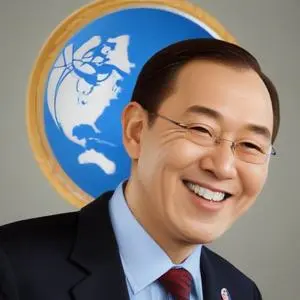
The 8th Secretary-General of the United Nations, a South Korean politician and diplomat who played a crucial role in promoting global peace, security, and sustainable development. He's known for his efforts to combat climate change and advocate for human rights.
Ban Ki-moon, a South Korean politician and diplomat, is best known for serving as the eighth Secretary-General of the United Nations (UN) from 2007 to 2016. During his tenure, he played a pivotal role in shaping the UN's response to global challenges, from climate change to conflict resolution.
Ban's journey to the top of the UN began in 2004, when he became the Foreign Minister of South Korea. His diplomatic prowess and ability to build relationships with world leaders made him a strong contender for the Secretary-General position. In 2006, he embarked on a campaign to become the UN's chief diplomat, visiting all the countries on the UN Security Council and garnering support from member states.
As Secretary-General, Ban implemented significant reforms to enhance the UN's efficiency and effectiveness. He introduced measures to improve peacekeeping operations, strengthen human rights, and promote sustainable development. His leadership also saw the adoption of the Sustainable Development Goals (SDGs) in 2015, a ambitious blueprint for achieving a more equitable and prosperous world by 2030.
Ban's dedication to global cooperation and sustainable development earned him numerous accolades, including:
After completing his second term as Secretary-General in 2016, Ban returned to South Korea, where he was considered a potential candidate for the presidential election. However, he announced in 2017 that he would not be running for the top office.
Ban Ki-moon's tenure at the UN left an indelible mark on global governance and international relations. His commitment to multilateralism, human rights, and sustainable development continues to inspire future generations of leaders and diplomats.
As a diplomat, Ban demonstrated that even the most unlikely candidate can rise to greatness with hard work, determination, and a steadfast commitment to making a difference in the world.
88 Years Old
A renowned international diplomat who led the United Nations from 1997 to 2006, promoting global cooperation and development, and receiving the Nobel Peace Prize in 2001.
Born in 1922
The first Arab to lead the United Nations, he played a key role in shaping international relations and global governance during a tumultuous period in the 1990s. He's also known for his efforts to reform the UN and promote peacekeeping operations.
84 Years Old
A Spanish physicist-turned-politician who served as Minister of Foreign Affairs, known for his diplomatic efforts in shaping the European Union's foreign policy. He played a key role in international crisis management and conflict resolution.
Born in 1905
A Swedish economist and diplomat who served as the 2nd Secretary-General of the United Nations, promoting international cooperation and peace, and posthumously awarded the Nobel Peace Prize. He's known for his tireless efforts to resolve global conflicts and promote humanitarian causes.
Born in 1909
A Burmese educator and diplomat who served as the 3rd United Nations Secretary-General, mediating international conflicts and promoting global cooperation. He's known for his quiet diplomacy and leadership during the Cold War era.
Born in 1918
An Austrian colonel and politician who served as the 9th President of Austria, known for his controversial past as a Nazi officer during World War II. He was also the Secretary-General of the United Nations from 1972 to 1981.
77 Years Old
The first Portuguese to lead the United Nations, he's a champion of global cooperation, human rights, and sustainable development. He's a prominent voice on the world stage, advocating for climate action and social justice.
77 Years Old
Acclaimed author of concise, witty, and poignant short stories and novels that explore the complexities of human relationships and the American experience.
