


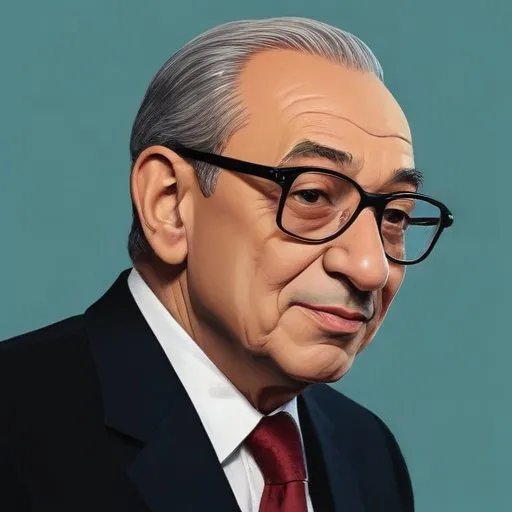
The first Arab to lead the United Nations, he played a key role in shaping international relations and global governance during a tumultuous period in the 1990s. He's also known for his efforts to reform the UN and promote peacekeeping operations.
Boutros Boutros-Ghali was a renowned Egyptian politician and diplomat who served as the sixth Secretary-General of the United Nations (UN) from 1992 to 1996. During his tenure, he oversaw the UN during several world crises, including the breakup of Yugoslavia and the Rwandan genocide.
Born on November 14, 1922, in Cairo, Egypt, Boutros-Ghali came from a Coptic Christian family. He pursued higher education in Egypt and France, earning a bachelor's degree in law from Cairo University in 1946. He later obtained a Ph.D. in international law from the University of Paris in 1949.
Before venturing into politics, Boutros-Ghali had a successful academic career. He taught international law and international relations at Cairo University from 1949 to 1979. During this period, he also wrote several books and articles on international relations and law.
Boutros-Ghali's political career began during the presidency of Anwar Sadat, who appointed him acting Minister of Foreign Affairs of Egypt in 1977. In this role, he played a key role in negotiating the Camp David Accords and the Egypt-Israel peace treaty between Sadat and Israeli prime minister Menachem Begin.
In 1991, Boutros-Ghali was elected as the Secretary-General of the United Nations by the UN General Assembly, succeeding Javier Pérez de Cuéllar. His tenure was marked by several crises, including the Somali Civil War, the Rwandan Civil War, and the Yugoslav Wars.
Despite facing criticism over UN inaction in Angola and during the genocide in Rwanda, Boutros-Ghali remained committed to his role. However, the perceived ineffectiveness of the UN peacekeeping operation in Bosnia led to a NATO intervention, which ultimately led to his failure to secure a second term as Secretary-General.
After leaving the UN, Boutros-Ghali served as the first Secretary-General of La Francophonie from 1997 to 2002. He then became the chairman of the South Centre, an intergovernmental think tank focused on promoting sustainable development.
Boutros Boutros-Ghali's legacy is marked by his commitment to international diplomacy and his efforts to address global crises during his tenure as Secretary-General of the United Nations. Despite facing criticism and controversy, he remained dedicated to promoting peace and sustainable development.
Boutros-Ghali was married to Leia Nadia Maria Boutros-Ghali, and they had no children together. He passed away on February 16, 2016, at the age of 93, leaving behind a legacy as a dedicated diplomat and statesman.
Throughout his distinguished career, Boutros Boutros-Ghali demonstrated his commitment to promoting peace, sustainable development, and international cooperation. His legacy continues to inspire future generations of diplomats and statesmen.
88 Years Old
A renowned international diplomat who led the United Nations from 1997 to 2006, promoting global cooperation and development, and receiving the Nobel Peace Prize in 2001.
82 Years Old
The 8th Secretary-General of the United Nations, a South Korean politician and diplomat who played a crucial role in promoting global peace, security, and sustainable development. He's known for his efforts to combat climate change and advocate for human rights.
77 Years Old
The first Portuguese to lead the United Nations, he's a champion of global cooperation, human rights, and sustainable development. He's a prominent voice on the world stage, advocating for climate action and social justice.
Born in 1920
A Peruvian politician and diplomat who served as the 135th Prime Minister of Peru and later became the fifth Secretary-General of the United Nations, playing a key role in international diplomacy and conflict resolution.
Born in 1905
A Swedish economist and diplomat who served as the 2nd Secretary-General of the United Nations, promoting international cooperation and peace, and posthumously awarded the Nobel Peace Prize. He's known for his tireless efforts to resolve global conflicts and promote humanitarian causes.
Born in 1909
A Burmese educator and diplomat who served as the 3rd United Nations Secretary-General, mediating international conflicts and promoting global cooperation. He's known for his quiet diplomacy and leadership during the Cold War era.
Born in 1918
An Austrian colonel and politician who served as the 9th President of Austria, known for his controversial past as a Nazi officer during World War II. He was also the Secretary-General of the United Nations from 1972 to 1981.
Born in 1905
A Swedish economist and diplomat who served as the 2nd Secretary-General of the United Nations, promoting international cooperation and peace, and posthumously awarded the Nobel Peace Prize. He's known for his tireless efforts to resolve global conflicts and promote humanitarian causes.
