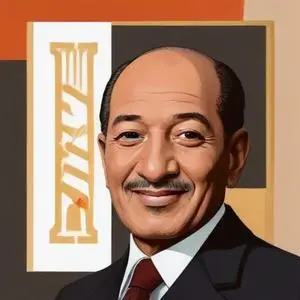
Anwar Sadat: The Visionary Leader Who Shaped Egypt's Future
Breaking Barriers and Making Peace
Anwar Sadat, the third president of Egypt, is renowned for his historic achievement of signing the 1978 Camp David Accords and the subsequent Egypt-Israel Peace Treaty, earning him the Nobel Peace Prize in 1979. This landmark agreement marked a significant shift in the Middle East's political landscape, making Sadat a hero in Egypt and the first Muslim Nobel laureate.
Early Life and Military Career
Born on December 25, 1918, in Mit Abu El Kom, Egypt, Sadat grew up in a poor family and was educated at the Egyptian Royal Military Academy. He graduated in 1938 and quickly rose through the ranks, becoming a senior officer in the Egyptian Army. Sadat played a key role in the 1952 Egyptian Revolution, which overthrew King Farouk I and led to the rise of
Gamal Abdel Nasser, under whom Sadat served as Vice President twice.
Rise to Power and Presidency
Following Nasser's death in 1970, Sadat succeeded him as President of Egypt, inheriting a country plagued by economic stagnation and political instability. Sadat's presidency was marked by a significant departure from Nasserism, as he introduced a multiparty system, launched the Infitah economic policy, and sought to reestablish relations with the Western world.
The Yom Kippur War and Road to Peace
In 1973, Sadat led Egypt in the Yom Kippur War, a surprise attack on Israel that aimed to reclaim the Sinai Peninsula, occupied by Israel since the 1967 Six-Day War. Although the war ended in a stalemate, Sadat's bravery and strategic planning earned him widespread admiration in Egypt and the Arab world. This experience, however, also led Sadat to reevaluate the futility of war and seek a peaceful solution to the Israeli-Palestinian conflict.
The Camp David Accords and Nobel Peace Prize
In 1978, Sadat, along with Israeli Prime Minister
Menachem Begin and US President
Jimmy Carter, forged the Camp David Accords, a historic agreement that paved the way for the Egypt-Israel Peace Treaty. This groundbreaking achievement earned Sadat and Begin the Nobel Peace Prize in 1979, recognizing their commitment to peace and diplomacy.
Controversies and Challenges
Sadat's decision to make peace with Israel was met with fierce opposition from the Arab world, the Palestine Liberation Organization (PLO), and even some Egyptians, who felt he had abandoned efforts to ensure a State of Palestine. Egypt was subsequently suspended from the Arab League from 1979 to 1989. Despite these challenges, Sadat remained resolute in his pursuit of peace and stability.
Personal Life and Assassination
Sadat was married to Jehan Sadat, a prominent women's rights activist, and had three daughters and one son. Tragically, Sadat's life was cut short on October 6, 1981, when he was assassinated by fundamentalist army officers during a military parade.
Legacy and Impact
Anwar Sadat's legacy is complex and multifaceted. While his peace treaty with Israel remains a contentious issue, his vision for a more peaceful and stable Middle East continues to inspire generations. Sadat's leadership and courage in the face of adversity have cemented his place as one of Egypt's most significant presidents, and his Nobel Peace Prize serves as a testament to his unwavering commitment to diplomacy and cooperation.
- Net Worth:Sadat's net worth was estimated to be around $100 million, largely due to his presidency and international recognition.
- Influence on Modern Society:Sadat's peace treaty with Israel has had a lasting impact on Middle Eastern politics, paving the way for future peace agreements and diplomatic efforts.
- Quotable Quote:"He who cannot change the very fabric of his thought will never be able to change reality, and will never, therefore, make any progress."
- Historical Context and Legacy:Sadat's presidency marked a significant shift in Egypt's post-revolutionary history, as he sought to transition from a socialist economy to a more open, market-oriented economy.
FAQ
What was Anwar Sadats role in the Camp David Accords?
Anwar Sadat, along with Israeli Prime Minister Menachem Begin, signed the Camp David Accords in 1978, a historic peace treaty between Israel and Egypt, for which he was awarded the Nobel Peace Prize.
How did Anwar Sadats presidency impact Egypt?
Anwar Sadats presidency had a significant impact on Egypt, as he implemented several economic and political reforms, including the countrys shift from a socialist to a capitalist economy.
What was Anwar Sadats early life and education?
Anwar Sadat was born in 1918 in Mit Abu El Kom, Egypt, and graduated from the Egyptian Military Academy in 1938, before pursuing a career in the military and politics.
How did Anwar Sadats assassination occur?
Anwar Sadat was assassinated on October 6, 1981, during a military parade in Cairo, by members of the Egyptian Islamic Jihad.
What is Anwar Sadats legacy in modern Egypt?
Anwar Sadats legacy in modern Egypt is complex, with some viewing him as a hero who brought peace and economic reform, while others criticize his authoritarian rule and economic policies.