


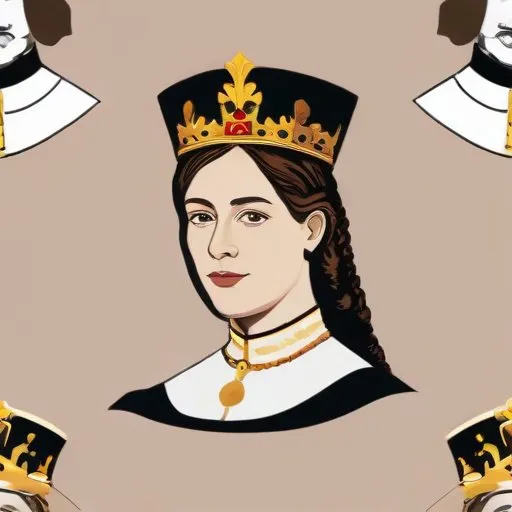
A German princess who married into the Swedish royal family and became queen, known for her strong personality and cultural influence in Sweden during the late 19th and early 20th centuries.
VICTORIA OF BADEN, born Sophie Marie Viktoria on August 7, 1862, was the Queen of Sweden from 1907 until her death in 1930 as the wife of King Gustaf V. She is remembered for her conservative politics and pro-German stance during World War I, which had significant implications for Sweden's political landscape.
VICTORIA was born at Karlsruhe Palace, Baden, to Grand Duke Frederick I of Baden and Princess Louise of Prussia. She was named after her aunt by marriage, Crown Princess Victoria of Prussia, daughter of Queen Victoria of the United Kingdom. Her early education was marked by a strict and Spartan upbringing, which focused on duty and hard work. She received private tutoring in the palace, learning languages, music, and art, and was given her confirmation in 1878.
In 1881, VICTORIA married Crown Prince Gustaf of Sweden and Norway, the son of King Oscar II of Sweden and Norway and Sofia of Nassau. The marriage was arranged as a sign that Sweden belonged to the German sphere in Europe and was attended by the German Emperor and Empress. From then on, she used the name VICTORIA and was known as The Vasa Princess, due to her descent from the old Vasa dynasty.
VICTORIA became the Queen of Sweden in 1907, when her husband ascended to the throne. During her reign, she was known for her conservative politics and her pro-German stance during World War I. She was also active in promoting the arts and culture in Sweden, and was a patron of various charitable organizations.
VICTORIA was a strong believer in duty and hard work, which was reflected in her own upbringing and education. She was also a proponent of the importance of women's roles in society, and was known to have supported women's rights and education.
VICTORIA's reign had a significant impact on Swedish politics and society. Her pro-German stance during World War I led to Sweden's declaration of neutrality in the conflict. Additionally, her support for women's rights and education contributed to the advancement of women's roles in Swedish society.
VICTORIA was a dedicated queen, who focused on promoting the arts and culture in Sweden. She was a patron of various charitable organizations and supported women's education and rights.
VICTORIA's reign was marked by significant historical events, including World War I and the rise of democracy in Europe. Her legacy is remembered as a strong and dedicated queen, who played an important role in shaping Sweden's politics and society during a tumultuous period in history.
Born in 1838
German princess who married into the Grand Duchy of Baden and became a patron of the arts, supporting notable composers and writers.
Born in 1831
The last German Emperor and King of Prussia, ruling for just 99 days, he's known for his liberal reforms and being the father of Wilhelm II, who led Germany into World War I.
Born in 1840
The eldest child of Queen Victoria and Prince Albert, she was a pioneering figure in British-German relations and a devoted wife and mother, known for her strong character and diplomatic skills.
Born in 1819
The German-born husband of Queen Victoria, who played a significant role in shaping British culture, politics, and arts, and is credited with organizing the Great Exhibition of 1851.
Born in 1859
The last German Emperor and King of Prussia, ruling from 1888 to 1918, known for his aggressive foreign policy and militarism that contributed to the outbreak of World War I. He was also known for his eccentric and impulsive behavior.
