


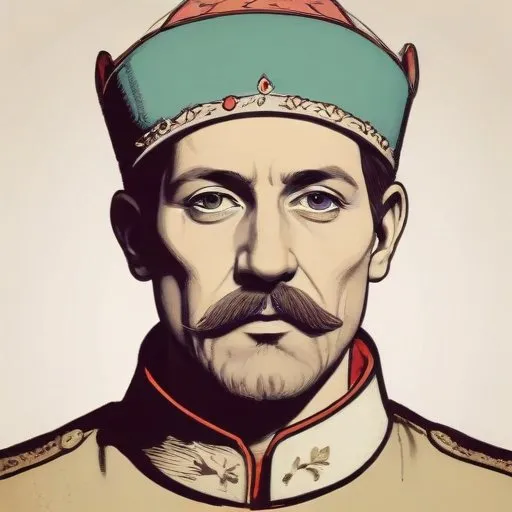
King of Hungary and Poland who ruled with an iron fist, expanding his kingdom and establishing a strong centralized government. He's also known for his military campaigns against the Ottoman Empire.
Louis I, also known as Louis the Great, is renowned for his extraordinary reign as King of Hungary and Croatia from 1342 and King of Poland from 1370, cementing his position as one of the most influential figures of the 14th century. He is celebrated for his military prowess, territorial expansions, and unwavering commitment to the Christian faith.
Born on March 5, 1326, Louis was the first child of Charles I of Hungary and Elizabeth of Poland to survive infancy. A 1338 treaty between his father and Casimir III of Poland, Louis's maternal uncle, secured his right to inherit the Kingdom of Poland if his uncle died without a son. This agreement set the stage for Louis's future conquests.
Louis launched a crusade against the Lithuanians, restoring royal power in Croatia and defeating a Tatar army, which expanded his authority towards the Black Sea. His military campaigns were instrumental in shaping the medieval landscape, with his troops occupying large territories in the Kingdom of Naples between 1347 and 1350. Although the Holy See never recognized his claim, Louis adopted the styles of Neapolitan sovereigns, including the title of King of Sicily and Jerusalem.
Louis's deeply religious mother, Elizabeth, exerted significant influence on him, shaping his worldview and policies. He inherited a centralized kingdom and a rich treasury from his father, which enabled him to administer Hungary with absolute power. Louis used royal prerogatives to grant privileges to his courtiers, solidifying his control over the kingdom.
Louis I's reign marked the pinnacle of medieval power in Central Europe, with his military conquests and territorial expansions shaping the region's history. His legacy is a testament to his unwavering commitment to the Christian faith and his ability to navigate the complex web of medieval politics.
Louis I's impact on modern society is multifaceted. His military campaigns and territorial expansions paved the way for future power struggles and alliances in Europe. Moreover, his commitment to the Christian faith shaped the religious landscape of the region, influencing the development of Catholicism in Eastern Europe.
In conclusion, Louis I of Hungary's extraordinary life and reign continue to captivate historians and scholars alike. His unwavering commitment to power, faith, and expansion has left an indelible mark on the medieval landscape, shaping the course of European history.
Born in 1500
Ruling over a vast empire from 1519 to 1556, he was a powerful and influential leader who played a crucial role in shaping European politics and religion. He is most known for his efforts to unify Christian Europe and defend it against the Ottoman Empire.
Born in 1310
The last Piast king of Poland, who reformed the country's judicial system, established universities, and promoted trade and commerce, earning him the title "the Great".
Born in 1337
Ruler of Luxembourg from 1354 to 1383, known for his military campaigns and territorial expansions, particularly the acquisition of the County of Chiny.
Born in 1500
Ruling over a vast empire from 1519 to 1556, he was a powerful and influential leader who played a crucial role in shaping European politics and religion. He is most known for his efforts to unify Christian Europe and defend it against the Ottoman Empire.
Born in 1503
The first Habsburg to rule the Holy Roman Empire, he unified Austria and introduced the concept of a hereditary monarchy, shaping European politics for centuries to come.
Born in 1459
First Holy Roman Emperor to rule simultaneously as King of the Romans and King of Spain, known for uniting fragmented German states and establishing the Habsburg dynasty.
