


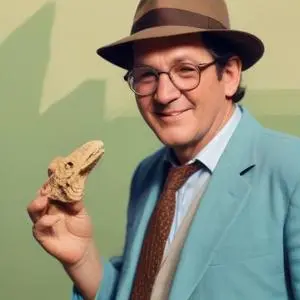
A pioneering palaeontologist and archaeologist who uncovered crucial evidence of human evolution in Africa, shedding light on the origins of humanity.
Renowned for his groundbreaking discoveries that reshaped our understanding of human evolution, Louis Leakey is celebrated as the Kenyan-British paleoanthropologist who demonstrated that humans originated in Africa. Through his meticulous excavations at Olduvai Gorge, Leakey, in collaboration with his wife Mary Leakey, provided conclusive evidence of humanity's African roots, revolutionizing the field of paleoanthropology.
Born on August 7, 1903, in Kabete, Kenya, Leakey grew up in a family of Church of England missionaries. His parents, Harry and Mary May Bazett Leakey, instilled in him a deep love for nature and the outdoors. Leakey's childhood was filled with fascinating encounters with African wildlife, which would later influence his passion for primatology and conservation.
Leakey's work at Olduvai Gorge, a site in Tanzania, began in the 1930s. Through his tireless efforts, he unearthed a wealth of fossil evidence, including the famous Zinj fossil, which dated back approximately 1.75 million years. This discovery, alongside others, helped establish Africa as the cradle of humanity, countering prevailing theories that placed human origins in Asia or Europe.
Leakey's legacy extends beyond his own research. He recognized the potential of three talented female researchers, Jane Goodall, Dian Fossey, and Birut Galdikas, and mentored them in their groundbreaking studies of primates in their natural habitats. Dubbed the "Trimates," these women went on to become leading authorities in the field of primatology, making significant contributions to our understanding of human evolution and conservation.
Leakey's concern for the welfare of animals and his commitment to preserving Africa's rich biodiversity led him to play a key role in establishing organizations dedicated to wildlife conservation and research. He worked tirelessly to promote the importance of protecting Africa's natural heritage, inspiring future generations to continue his work.
Louis Leakey's contributions to paleoanthropology, primatology, and conservation have had a profound impact on our understanding of human evolution and the natural world. His work has inspired generations of researchers, conservationists, and scientists, cementing his place as a pioneer in the field of paleoanthropology.
As we reflect on Leakey's remarkable life and achievements, we are reminded of the importance of protecting Africa's rich cultural and natural heritage. His legacy serves as a testament to the power of discovery, passion, and dedication, inspiring us to continue exploring, learning, and protecting our planet's precious resources.
Born in 1913
A pioneering archaeologist and anthropologist who uncovered crucial fossils and artifacts in Africa, shedding light on human evolution and ancient cultures.
81 Years Old
A renowned Kenyan paleontologist and politician, he led expeditions that uncovered significant fossil discoveries, including early human ancestors, and later fought against elephant poaching and corruption.
83 Years Old
Famous for discovering the 3.2 million-year-old fossil "Lucy," a groundbreaking find that shed light on human evolution, and pioneering the field of paleoanthropology.
92 Years Old
Renowned for groundbreaking chimpanzee research and tireless conservation efforts, this trailblazing scientist has greatly advanced our understanding of primates and the natural world.
94 Years Old
Renowned for groundbreaking research on mountain gorillas, this dedicated scientist fought tirelessly to protect these magnificent creatures and their habitats.
Born in 1893
Discovered the first early human species, Australopithecus africanus, and introduced the concept of "killer ape" theory, which suggests that human evolution was driven by violence and aggression.
