


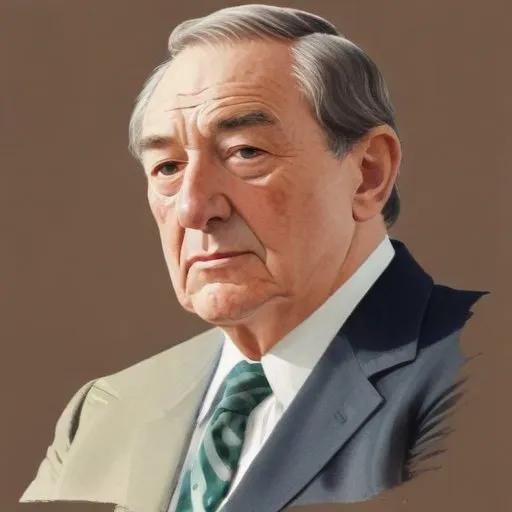
A renowned Kenyan paleontologist and politician, he led expeditions that uncovered significant fossil discoveries, including early human ancestors, and later fought against elephant poaching and corruption.
Richard Leakey is renowned for his groundbreaking discoveries in paleoanthropology and his tireless efforts in wildlife conservation. As a Kenyan paleoanthropologist, conservationist, and politician, Leakey has left an indelible mark on the fields of archaeology, wildlife conservation, and politics.
Born on December 19, 1944, in Nairobi, Kenya, Richard Leakey was the son of Louis and Mary Leakey, both prominent paleoanthropologists. Growing up in a household steeped in scientific inquiry, Leakey was exposed to the wonders of archaeology and the natural world from a young age. His parents' excavations at Olduvai Gorge and Lake Turkana sparked his interest in human evolution and the natural environment.
Leakey's academic pursuits led him to the University of Nairobi, where he earned a degree in archaeology and anthropology. His early career was marked by significant discoveries, including the finding of the 1.8-million-year-old Homo erectus skull at Lake Turkana in 1969. This discovery catapulted Leakey to international recognition and solidified his reputation as a leading paleoanthropologist.
In addition to his work in paleoanthropology, Leakey was a passionate advocate for wildlife conservation. He founded the NGO WildlifeDirect and served as the chairman of the Kenya Wildlife Service, working tirelessly to protect Kenya's natural heritage and combat wildlife trafficking.
Leakey's influence extended beyond the realm of science and conservation to politics. He served as the cabinet secretary and head of public service in the Kenyan government, utilizing his expertise to drive policy reforms and promote sustainable development.
Leakey's contributions to science, conservation, and politics have been recognized with numerous awards and honors, including the National Geographic Society's Centennial Award, the Hubbard Medal, and the Presidential Medal of Honor.
In 1956, Leakey suffered a near-fatal fall from a horse, fracturing his skull and nearly dying. This incident, incidentally, saved his parents' marriage. Leakey has also faced controversy, including allegations of corruption during his tenure as the head of the Kenya Wildlife Service.
Richard Leakey's legacy extends far beyond his individual achievements. He has inspired generations of scientists, conservationists, and politicians, leaving an indelible mark on the fields of paleoanthropology, wildlife conservation, and politics. His tireless advocacy for the preservation of Kenya's natural heritage continues to shape policy and practice in the region.
"I think the most important thing is to be committed to what you're doing, and to be passionate about it."
"The biggest challenge is to get people to understand that conservation is not just about animals, it's about people."
Leakey's contributions to paleoanthropology and conservation are often compared to those of his contemporaries, including Donald Johanson and Jane Goodall. While each of these individuals has made significant contributions to their respective fields, Leakey's unique blend of scientific expertise and political acumen sets him apart as a truly exceptional figure.
Richard Leakey's remarkable life and achievements serve as a testament to the power of human curiosity, passion, and dedication. His enduring legacy continues to inspire and motivate scientists, conservationists, and politicians around the world.
Born in 1903
A pioneering palaeontologist and archaeologist who uncovered crucial evidence of human evolution in Africa, shedding light on the origins of humanity.
Born in 1913
A pioneering archaeologist and anthropologist who uncovered crucial fossils and artifacts in Africa, shedding light on human evolution and ancient cultures.
83 Years Old
Famous for discovering the 3.2 million-year-old fossil "Lucy," a groundbreaking find that shed light on human evolution, and pioneering the field of paleoanthropology.
92 Years Old
Renowned for groundbreaking chimpanzee research and tireless conservation efforts, this trailblazing scientist has greatly advanced our understanding of primates and the natural world.
94 Years Old
Renowned for groundbreaking research on mountain gorillas, this dedicated scientist fought tirelessly to protect these magnificent creatures and their habitats.
