


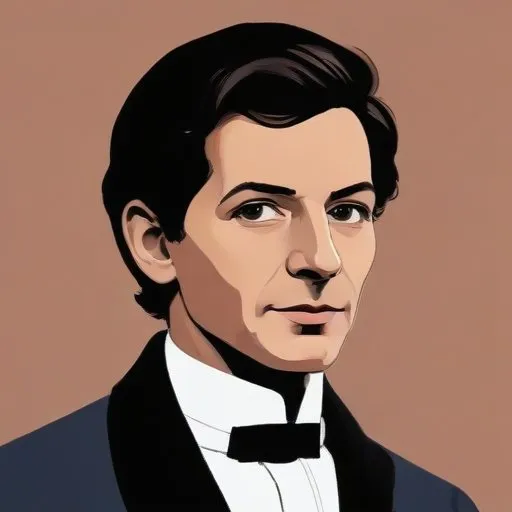
A 19th-century painter of sentimental and often melancholic scenes, particularly of Swiss peasants and landscapes. His works are characterized by their warm, golden light and attention to detail.
Louis Lopold Robert was a renowned Swiss painter, celebrated for his captivating depictions of Italian life and landscapes. Born on May 13, 1794, in La Chaux-de-Fonds, Neuchâtel, Switzerland, Robert's artistic journey took him from Paris to Rome, capturing the essence of Italy's people, culture, and beauty.
At the tender age of 16, Robert left his native Switzerland to pursue his artistic dreams in Paris, under the guidance of engraver Jean Girardet. However, his hopes of winning the grand prix for engraving were dashed in 1815 when Neuchâtel was restored to Prussia, and he was struck off the list of competitors as a foreigner.
Undeterred, Robert continued his studies under Girardet and frequented the studio of Jacques-Louis David, where he developed his skills as a painter. When David was exiled, Robert returned to Neuchâtel, where he attracted the attention of Roullet de Mezerac, who provided him with a timely loan to proceed to Rome.
In Rome, Robert's artistic vision flourished as he immersed himself in the Italian way of life. He executed numerous detached studies of Italian life, showcasing his unique ability to capture the historical characteristics of the Italian people. These studies laid the foundation for his most iconic works, which would represent the four seasons in Italy and the four leading races of its people.
Robert's masterpiece, "The Return from the Fête of the Madonna dell'Arco" (Louvre), depicted the Neapolitans and the spring season, achieving great success at the Salon of 1827. The painting was purchased by Charles X for the Luxembourg.
In 1831, Robert's "Summer Reapers arriving in the Pontine Marshes" (Louvre) solidified his reputation as a master painter. This work was acquired by Louis Philippe and showcased Robert's ability to capture the essence of Italian life.
Unfortunately, Robert's personal life took precedence over his art, and he abandoned his planned third work, "Florence and her autumn vineyards," due to his passion for Princess Charlotte Napoleon, who was mourning the death of her husband.
Instead, Robert traveled to Venice, where he created his fourth and final work in the series, "The Fishers of the Adriatic." Although not equal to his previous masterpieces, this work demonstrated Robert's continued fascination with Italian life.
Louis Lopold Robert's contributions to the art world are undeniable. His paintings not only showcased the beauty of Italy but also provided a glimpse into the country's rich cultural heritage. Today, his works can be found in prominent museums, such as the Louvre, and continue to inspire artists and art lovers alike.
Through his art, Robert left an indelible mark on the world, capturing the essence of Italy's people, landscapes, and culture. His legacy serves as a testament to the power of art to transcend time and borders, leaving behind a timeless tribute to the beauty of Italy.
Born in 1780
A renowned French Neoclassicist painter and illustrator, celebrated for his exquisite portraits and historical scenes that epitomize elegance and refinement. His work continues to inspire artists and art enthusiasts alike.
Born in 1798
A Romantic-era master of expressive brushstrokes and vivid color, creating iconic works that captured the drama and emotion of historical and literary scenes.
Born in 1791
A Romantic-era master of dramatic and emotionally charged art, known for his powerful depictions of horses and the human experience.
Born in 1746
A visionary artist who pioneered Romanticism, capturing the human experience through bold, emotionally charged paintings and sculptures that continue to inspire and unsettle.
Born in 1776
A Romantic-era painter celebrated for capturing the essence of the English countryside through serene, naturalistic landscapes, often featuring skies and clouds.
Born in 1774
A 19th-century Romantic painter and etcher, renowned for his mystical and contemplative landscapes that often featured ruins, mountains, and misty skies, evoking a sense of spirituality and connection to nature.
Born in 1777
A Romantic-era painter and illustrator renowned for his vibrant, emotive landscapes and portraits that captured the essence of German folklore. His works often featured dreamlike, mystical scenes that evoked a sense of wonder and enchantment.
