


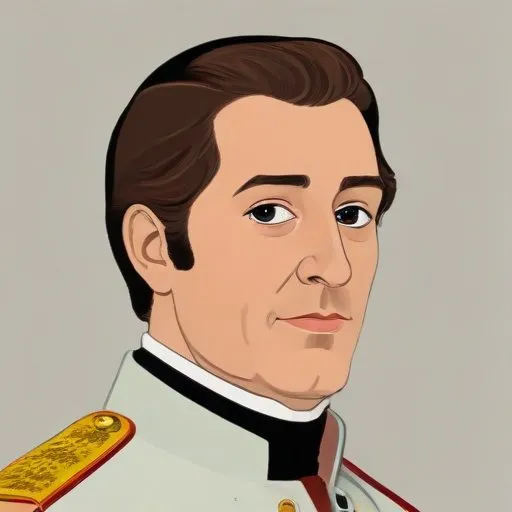
The last king of France before the Second Republic, known for his liberal policies and abdication during the July Revolution of 1848. He reigned from 1830 to 1848, a period of relative peace and economic growth.
Louis Philippe I, Duke of Orléans, was known as "le Gros" (the Fat) and was a prominent figure in the French royal court. As the First Prince of the Blood, he held significant influence and power, using his wealth and position to shape the course of French history.
Born on May 12, 1725, at the Palace of Versailles, Louis Philippe was the only son of Louis, Duke of Orléans, and his wife Johanna of Baden-Baden. He was titled Duke of Chartres at birth and was one of two children, with his younger sister Louise Marie d'Orléans dying at a young age.
Following the death of his father in 1752, Louis Philippe inherited the vast wealth and lands of the House of Orléans, becoming one of the richest men in France. He used his newfound power and influence to solidify his position as the most senior male at the French court after the immediate royal family.
Louis Philippe's first marriage was to Louise Henriette de Bourbon, a member of the House of Bourbon-Conti, in 1743. The union was arranged to close a fifty-year-old family rift, but it ultimately ended in divorce in 1757. He later married Stephanie de Beauharnais, a relative of the Empress Josephine, in 1773.
Louis Philippe was a patron of the arts, supporting numerous artists, writers, and musicians. He also made significant contributions to the city of Paris, including the construction of the Palais-Royal, which became a hub for artistic and intellectual activity.
Through his vast wealth, cultural contributions, and influential position, Louis Philippe left a lasting impact on French society. His son, Philippe Égalité, would go on to play a key role in the French Revolution, further solidifying the House of Orléans' place in French history.
Louis Philippe's legacy extends beyond his own lifetime, with his patronage of the arts and his cultural contributions shaping French society for generations to come. His influence can still be seen in the cultural institutions and landmarks that he supported and developed.
Born in 1755
The last queen of France before the French Revolution, known for her extravagance and mismanagement of the French economy, which contributed to the downfall of the monarchy.
Born in 1769
A French military leader who rose to prominence during the French Revolution and became Emperor of France, known for his military conquests and reorganization of Europe. He is also famous for his Napoleonic Code, which remains a foundation of modern law.
Born in 1758
Radical leader of the French Revolution, instrumental in the Reign of Terror, and advocate for the execution of King Louis XVI.
Born in 1759
A leading figure of the French Revolution, instrumental in the overthrow of the monarchy and establishment of the First French Republic, known for his radical Jacobin ideology.
Born in 1755
A key figure in the French Revolution, leading the coup that overthrew Maximilien Robespierre and later serving as a key advisor to Napoleon Bonaparte. He played a crucial role in shaping French politics during a tumultuous period.
Born in 1760
French journalist and politician who sparked the French Revolution with his impassioned speeches and writings, advocating for democracy and social reform.
