


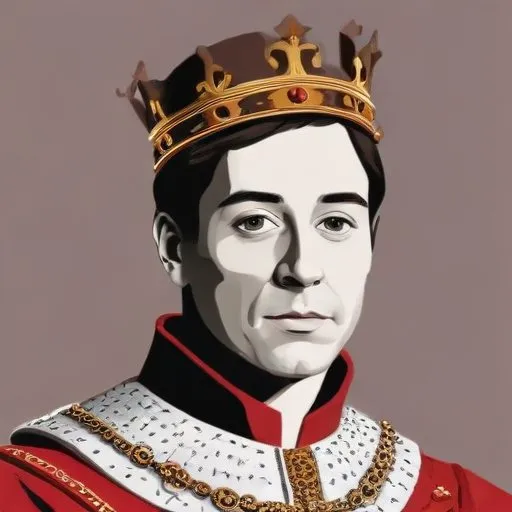
Reigned from 1108 to 1137, this king strengthened the French monarchy and expanded its territories through strategic marriages and military campaigns. He's also known for his patronage of the arts and architecture.
Louis VI, also known as Louis the Fat, was the King of the Franks from 1108 to 1137, making significant contributions to centralizing the institutions of royal power in France. He is renowned for his military exploits, earning him the epithet "the Fighter" (le Batailleur), and his efforts to bring lawless knights to justice.
Born around 1081 in Paris, Louis was the son of Philip I and Bertha of Holland. According to Abbot Suger of Saint Denis, who wrote a biography of Louis VI, the young prince was characterized by his courage and vigor, preferring the pursuit of arms over boyish games.
In 1098, Louis was knighted by Guy I of Ponthieu, and by 1103, he was already involved in the government of the kingdom alongside his father. Upon Philip I's death in 1108, Louis succeeded him as King of the Franks.
Louis VI spent much of his 29-year reign fighting against the robber barons who plagued the Île de France and Henry I of England for his continental possessions in Normandy. Despite his weight, which became a significant obstacle in his later years, Louis continued to lead his troops in battle, earning him the nickname "the Fat" (le Gros).
One of his most notable achievements was issuing ordonnances, or decrees, that applied to the whole of the kingdom of France, a first for the House of Capet. This move significantly reinforced his power and consolidated the institutions of royal authority.
In 1104, Louis married Lucienne de Rochefort, the daughter of his father's seneschal, but repudiated her three years later. They had no children. Louis's life was marked by his relationships with his advisors, including Abbot Suger, who played a significant role in shaping his policies and legacy.
Louis VI's reign marked a significant turning point in French history, as he successfully centralized power and established the foundations for the strong French monarchy that would follow. His military campaigns and administrative reforms paved the way for the growth of the French kingdom, cementing his place as one of the most important rulers of the Middle Ages.
Through his military prowess, administrative reforms, and personal relationships, Louis VI left an indelible mark on French history, earning him a place among the most celebrated rulers of the Middle Ages.
Born in 1052
King of France from 1060 to 1108, known for his military campaigns and conflicts with the Church, particularly his excommunication by Pope Urban II.
Born in 1052
King of France from 1060 to 1108, known for his military campaigns and conflicts with the Church, particularly his excommunication by Pope Urban II.
Born in 1785
The last king of the French monarchy before the French Revolution, known for his tragic and mysterious life, including his imprisonment and disputed death.
Born in 1338
The King of France from 1364 to 1380, known for his military victories and rebuilding of Paris, earning him the nickname "Charles the Wise".
Born in 1319
King of France from 1350 to 1364, known for being captured by the English during the Hundred Years' War and later ransomed.
Born in 1519
King of France from 1547 to 1559, known for his cultural and artistic patronage, and his role in the Italian Wars.
Born in 1710
The monarch who ruled France from 1715 to 1774, known as the "Sun King's" great-grandson, and remembered for his extravagance, absolutism, and the decline of the French monarchy.
