


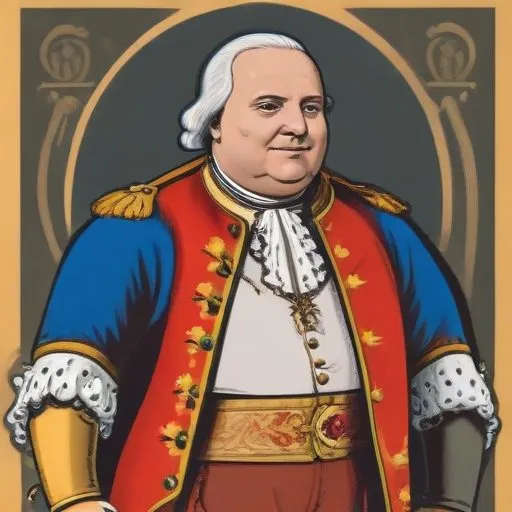
The restored monarch who ended Napoleon's reign and re-established the French monarchy after a decade of revolution and empire, known for his moderate policies and constitutional monarchy.
Louis XVIII, also known as the Desired, was the King of France who restored the Bourbon dynasty after the tumultuous years of the French Revolution and Napoleon's reign. He is famously remembered for re-establishing the monarchy, establishing a constitutional government, and modernizing France's institutions.
Born on November 17, 1755, Louis XVIII was the younger brother of King Louis XVI, who would later be executed during the French Revolution. As the Count of Provence, Louis XVIII lived a life of luxury and excess, earning him a reputation as a pleasure-seeking prince. However, his life took a dramatic turn when the French Revolution began in 1789. Fearing for his life, Louis XVIII fled France, taking refuge in various European courts.
In 1814, Napoleon Bonaparte was defeated, and Louis XVIII was called back to France to reclaim the throne. He was greeted as a hero, and his restoration marked the beginning of the Bourbon Restoration. Louis XVIII ruled France from 1814 to 1824, during which time he implemented various reforms to modernize France's institutions and economy.
Louis XVIII's most significant contribution was the establishment of a constitutional monarchy in France. He signed the Charter of 1814, which limited the monarch's power and established a bicameral legislature. This move earned him the respect of the French people and marked a significant shift towards democracy.
Louis XVIII was a strong believer in the principles of the Enlightenment, advocating for reason, individual liberties, and limited government intervention. He was influenced by the philosophies of Montesquieu and Voltaire, which shaped his views on governance and human rights.
Louis XVIII's reign had a lasting impact on modern society. His establishment of a constitutional monarchy paved the way for the development of liberal democracies across Europe. His reforms also laid the foundation for France's economic growth and industrialization in the 19th century.
Louis XVIII's legacy is complex and multifaceted. While he is often criticized for his luxurious lifestyle and initial reluctance to accept the principles of the Revolution, he played a crucial role in stabilizing France after the tumultuous years of Napoleon's rule. His establishment of a constitutional monarchy paved the way for the development of liberal democracies in Europe.
Today, Louis XVIII is remembered as a wise and pragmatic leader who navigated the treacherous waters of French politics to save the monarchy and modernize France's institutions. His reign marked a significant turning point in French history, laying the foundation for the country's growth and prosperity in the 19th and 20th centuries.
In conclusion, Louis XVIII's remarkable story is one of redemption, pragmatism, and vision. From his early life of luxury to his courageous return to France, Louis XVIII navigated the complexities of French politics to establish a constitutional monarchy, modernize France's institutions, and pave the way for the country's future growth and prosperity.
Born in 1769
A French military leader who rose to prominence during the French Revolution and became Emperor of France, known for his military conquests and reorganization of Europe. He is also famous for his Napoleonic Code, which remains a foundation of modern law.
Born in 1755
The last queen of France before the French Revolution, known for her extravagance and mismanagement of the French economy, which contributed to the downfall of the monarchy.
Born in 1710
The monarch who ruled France from 1715 to 1774, known as the "Sun King's" great-grandson, and remembered for his extravagance, absolutism, and the decline of the French monarchy.
Born in 1338
The King of France from 1364 to 1380, known for his military victories and rebuilding of Paris, earning him the nickname "Charles the Wise".
Born in 1519
King of France from 1547 to 1559, known for his cultural and artistic patronage, and his role in the Italian Wars.
