


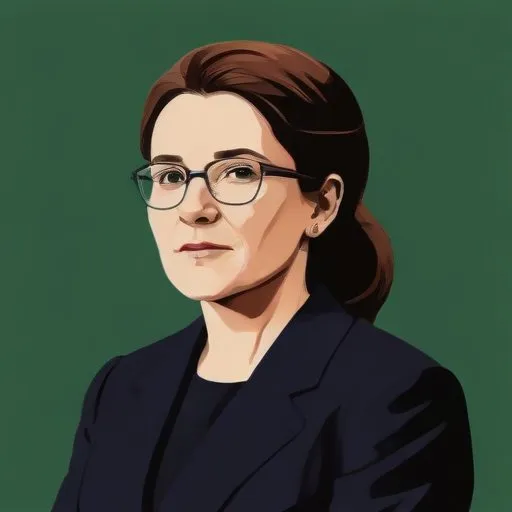
A renowned expert on terrorism and international security, known for her groundbreaking research and leadership in academia.
Louise Richardson is renowned for her authoritative expertise in the field of terrorism, a subject she has dedicated her career to understanding and analyzing. As a prominent political scientist, she has made significant contributions to the study of this complex and multifaceted phenomenon, earning her international recognition and accolades.
Born on June 8, 1958, in Ireland, Richardson grew up in Tramore, County Waterford, as one of seven children to Arthur and Julie Richardson. Her educational pursuits took her to the University of California, where she spent a year as a Rotary Scholar, before returning to Trinity College, Dublin, to complete her Bachelor of Arts degree in history in 1980. Richardson's academic trajectory continued with a Master's degree in political science from UCLA in 1981, followed by a Master's and PhD in government from Harvard University in 1984 and 1989, respectively.
Richardson's academic and leadership career has been marked by several notable appointments. She served as the executive dean of the Radcliffe Institute for Advanced Study at Harvard University, followed by her tenure as the principal and vice-chancellor of the University of St Andrews. In 2016, she became the first female vice-chancellor of the University of Oxford, a position she held until 2022. Most recently, she assumed the role of president of the Carnegie Corporation of New York in January 2023.
Richardson's scholarly work has focused on the complexities of terrorism, and she has written extensively on the subject. Her research has explored the motivations and strategies of terrorist groups, as well as the responses of governments and civil societies to these threats. Her work has been widely cited and has influenced the development of counter-terrorism policies and strategies.
During her tenure as vice-chancellor of the University of Oxford, Richardson played a crucial role in the successful development of a vaccine to combat the COVID-19 pandemic. Her leadership and vision helped to facilitate collaboration between academics, researchers, and industry partners, leading to the creation of a life-saving vaccine.
Richardson has received numerous awards and honors for her contributions to academia and public service. She was appointed Dame Commander of the Order of the British Empire (DBE) in 2015 for her services to higher education and international relations.
Louise Richardson's legacy extends far beyond her academic accomplishments. Her work has had a profound impact on our understanding of terrorism and its consequences, informing policies and strategies that have improved global security. Her leadership and vision have inspired a new generation of scholars and policymakers, ensuring that her contributions will continue to shape our responses to complex global challenges.
Richardson's work is underpinned by a deep understanding of the complexities of human behavior and the role of power and politics in shaping global events. Her philosophical approach emphasizes the importance of nuance, context, and interdisciplinary collaboration in addressing the challenges posed by terrorism.
Through her remarkable career, Louise Richardson has demonstrated an unwavering commitment to advancing our understanding of terrorism and its implications for global security. Her contributions have left an indelible mark on the academic community, and her legacy will continue to shape our responses to complex global challenges.
71 Years Old
The first African American woman to serve as Secretary of State, she played a crucial role in shaping US foreign policy during a tumultuous period, earning her a lasting legacy in international relations.
89 Years Old
The first female US Secretary of State, serving from 1997 to 2001, who played a key role in shaping American foreign policy during the Clinton administration. She's known for her strong diplomatic efforts and advocacy for democracy and human rights.
79 Years Old
A highly influential American politician and diplomat who served as Secretary of State and First Lady, known for her advocacy on women's rights and international diplomacy.
72 Years Old
The first female Chancellor of Germany, serving for 16 years, known for her leadership during the European sovereign-debt crisis and her role in shaping the European Union's policy. She's a highly influential figure in modern politics.
70 Years Old
The second female Prime Minister of the United Kingdom, leading the country through Brexit negotiations and implementing policies on national security and education. Known for her strong stance on immigration and law and order.
Born in 1925
The first female Prime Minister of the United Kingdom, serving from 1979 to 1990, known for her conservative policies and leadership during the Falklands War.
65 Years Old
The first female Prime Minister of Australia, serving from 2010 to 2013, known for her progressive policies and leadership during a period of significant economic reform.
70 Years Old
A highly influential leader in global economics, serving as the head of the International Monetary Fund, shaping international monetary policies and promoting global financial stability. Known for her strong leadership and vision for a more equitable economic future.
