


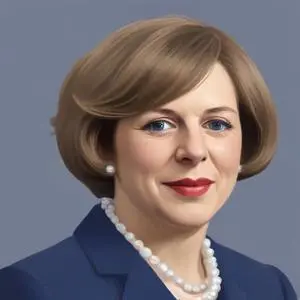
The second female Prime Minister of the United Kingdom, leading the country through Brexit negotiations and implementing policies on national security and education. Known for her strong stance on immigration and law and order.
Theresa May, the second female Prime Minister of the United Kingdom, is known for her unwavering dedication to public service and her trailblazing career in British politics. As the longest-serving Home Secretary in over 60 years and the first woman to hold two of the Great Offices of State, May's legacy is marked by her commitment to conservatism and her unrelenting pursuit of policy reform.
Born on October 1, 1956, in Eastbourne, Sussex, May grew up in Oxfordshire and was educated at St. Hugh's College, Oxford, where she graduated in 1977 with a degree in geography. Her early life was marked by a strong sense of public duty, which would later propel her to a career in politics.
May's entry into politics began in the 1980s, when she served as a councillor for Durnsford in Merton. Her first two attempts to be elected to the House of Commons were unsuccessful, but she finally succeeded in 1997, becoming the Member of Parliament for Maidenhead. Throughout her parliamentary career, May held various roles in shadow cabinets, including Chair of the Conservative Party from 2002 to 2003.
In 2010, May was appointed Home Secretary and Minister for Women and Equalities, a role she held until 2016. During her tenure, she implemented several key reforms, including the introduction of elected police and crime commissioners, the deportation of Abu Qatada, and the creation of the College of Policing and the National Crime Agency. May's hardline stance on drugs policy led to the banning of khat, and she also pursued reform of the Police Federation.
Following the 2016 referendum, May became the Prime Minister of the United Kingdom, succeeding David Cameron. During her premiership, she oversaw the UK's withdrawal from the European Union, a process that proved highly contentious and divisive. Despite facing numerous challenges, May remained committed to her vision for the UK's future, earning her a reputation as a leader of unwavering resolve.
May's political ideology is rooted in one-nation conservatism, which emphasizes the importance of social cohesion and national unity. Throughout her career, she has been driven by a commitment to social justice and a belief in the importance of strong public institutions. Her leadership style is characterized by a willingness to take tough decisions and her unwavering commitment to her policies.
May's legacy extends beyond her political achievements, with her leadership style and policy reforms having a lasting impact on modern British society. Her commitment to social justice and her pursuit of policy reform have inspired countless individuals, particularly women, to pursue careers in politics and public service.
May's premiership was not without controversy, with her leadership style and policy decisions often sparking intense debate and criticism. Despite this, she remained a figure of unwavering resolve, earning her a reputation as a leader who was unafraid to take tough decisions.
"If you believe you are a citizen of the world, you are a citizen of nowhere."
May's place in British history is secure, with her leadership marking a significant turning point in the country's political trajectory. Her commitment to conservatism and her pursuit of policy reform have left a lasting legacy, cementing her status as one of the most important female politicians of her generation.
59 Years Old
The former Prime Minister of the United Kingdom who led the country from 2010 to 2016, known for his role in the Brexit referendum and austerity measures.
55 Years Old
Former Chancellor of the Exchequer who oversaw the UK's economy during a period of austerity, implementing significant spending cuts and tax reforms. Known for his role in shaping the country's economic policy.
70 Years Old
Former Chancellor of the Exchequer, overseeing UK's economy and finances, implementing fiscal policies and budgets. Known for his cautious approach to public spending and Brexit negotiations.
62 Years Old
Former Prime Minister of the United Kingdom and former Mayor of London, known for his charismatic leadership and Brexit advocacy. He led the UK's withdrawal from the European Union.
58 Years Old
A Scottish journalist and politician who served as Secretary of State for Education, known for his efforts to reform the UK's education system and his role in the Brexit campaign.
59 Years Old
A British politician who served as Secretary of State for Health, overseeing the UK's National Health Service (NHS) and implementing various healthcare reforms. He's known for his efforts to modernize the NHS and improve patient care.
62 Years Old
A British politician who led the UK Independence Party and played a key role in the Brexit movement, advocating for the UK's withdrawal from the EU.
73 Years Old
The former Prime Minister of the United Kingdom who led the country through a transformative period, including the Iraq War, and is known for his charismatic leadership and controversial decisions.
