


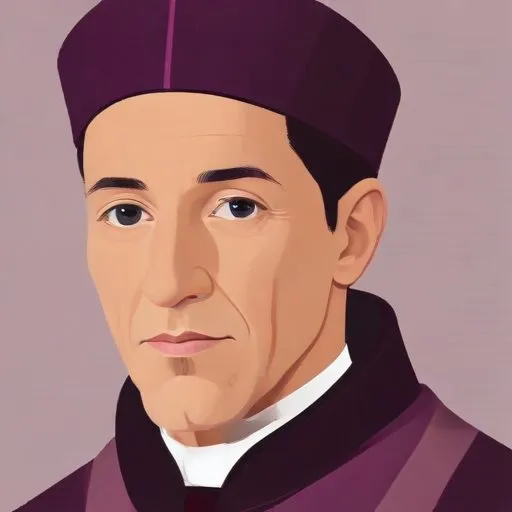
A 13th-century French bishop who renounced his claim to the throne of Naples to pursue a life of spiritual devotion, and is now revered as a saint for his piety and charitable works.
Louis of Toulouse, also known as Louis of Anjou, is revered for his remarkable transition from a Neapolitan prince to a devoted Catholic bishop, renouncing his royal heritage for a life of service and spirituality. This extraordinary shift in his life's trajectory earned him a prominent place in the annals of history, cementing his status as a saint in the Catholic Church.
Born on February 9, 1274, in Brignoles, Provence, or Nocera, Italy, Louis was the second son of King Charles II of Naples and Mary of Hungary. His early life took a dramatic turn when his father, Charles, was taken prisoner by King Peter III of Aragon during the Sicilian Vespers. As part of the agreement to secure his father's release, Louis and his brothers were held as hostages in Catalonia for seven years, under the care of Franciscan friars.
It was during this period of captivity that Louis developed a deep affinity for philosophy and theology, influenced by the guidance of Franciscan friar Arnauld de Villeneuve. This experience laid the foundation for his future career in the Church. Upon reaching his majority, Louis was appointed archbishop of Lyon, although he remained in captivity.
In 1295, Louis's older brother succumbed to the plague, making him the heir apparent to his father's kingdom. However, upon his release from captivity, Louis opted to renounce his claims to the Angevin inheritance in favor of his brother Robert. This bold decision paved the way for his eventual entry into the Franciscan Order, where he would take vows of poverty, chastity, and obedience.
On February 5, 1297, Louis was consecrated Bishop of Toulouse by Pope Boniface VIII. This appointment placed him in a delicate position, as it was a territory vital to Angevin interests, and his granduncle Alphonse had previously held the title of count before his death in 1271. Despite his royal background, Louis quickly earned a reputation for his devotion to the poor, feeding the hungry, and disregarding his own needs.
Unfortunately, Louis's time as Bishop of Toulouse was short-lived. After merely six months, he abandoned the position, reportedly exhausted by his labors. This unexpected decision was soon followed by his untimely death on August 19, 1297, in Brignoles, Provence.
Louis of Toulouse's extraordinary story of renunciation and devotion has inspired countless generations. He was canonized a saint in 1327, and his feast day is celebrated on August 19. His relics are preserved in the Cathedral of Saint-Étienne in Toulouse, France, a testament to his enduring legacy.
Louis of Toulouse's remarkable journey serves as a powerful reminder of the transformative power of faith and the enduring impact of selfless devotion.
Born in 1165
King of France from 1180 to 1223, known for his military conquests, including the Battle of Bouvines, and his role in the Third Crusade.
Born in 1052
King of France from 1060 to 1108, known for his military campaigns and conflicts with the Church, particularly his excommunication by Pope Urban II.
Born in 1319
King of France from 1350 to 1364, known for being captured by the English during the Hundred Years' War and later ransomed.
Born in 1214
King of France from 1226 to 1270, leading the Seventh and Eighth Crusades, and establishing a strong, centralized government. He's also revered for his justice and piety.
Born in 1052
King of France from 1060 to 1108, known for his military campaigns and conflicts with the Church, particularly his excommunication by Pope Urban II.
