


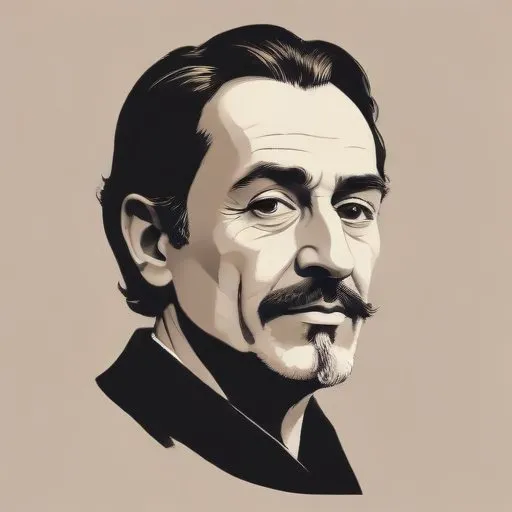
A Romanian literary giant, celebrated for his avant-garde poetry and philosophical explorations of existence, culture, and human condition. His works are a testament to the country's rich cultural heritage.
Lucian Blaga, a towering figure in Romanian philosophy, poetry, and literature, left an indelible mark on the country's cultural landscape. As a philosopher, poet, playwright, translator, and novelist, Blaga's work spanned multiple disciplines, earning him a reputation as a commanding personality of the interbellum period.
Blaga was born on May 9, 1895, in Lancrăm, a small village near Alba Iulia, Transylvania. His father, an Orthodox priest, played a significant role in shaping Blaga's early childhood, which he later described as being under the "sign of the incredible absence of the word." After completing his primary education in Hungarian, Blaga attended the Andrei Șaguna high school in Brașov from 1906 to 1914, under the supervision of a relative.
Blaga's philosophical journey began during World War I, when he started theological studies in Sibiu. He graduated in 1917 and published his first philosophy article on the Bergson theory of subjective time. Between 1917 and 1920, he attended courses at the University of Vienna, where he earned his PhD in philosophy.
Blaga's literary prowess is evident in his poetry, plays, and novels. His work often explored themes of existence, time, and the human condition. As a translator, he introduced Romanian readers to the works of renowned philosophers like Henri Bergson and Søren Kierkegaard.
In 1926, Blaga entered the Romanian diplomatic service, holding posts in Poland, Czechoslovakia, Portugal, Switzerland, and Austria. His connections with Octavian Goga, a relative of his wife and fellow Transylvanian poet, facilitated his appointments. In 1936, Blaga was elected a titular member of the Romanian Academy, delivering a seminal acceptance speech titled "Elogiul satului romnesc" (In Praise of the Romanian Village). He later became a professor of cultural philosophy at the University of Cluj in 1939.
During World War II, Blaga edited the annual magazine Saeculum in Sibiu. Although dismissed from his university professorship in 1948, his contributions to Romanian culture and philosophy remain unparalleled. Through his work, Blaga inspired generations of Romanian thinkers, writers, and artists, solidifying his position as a cultural icon of the interbellum period.
"The mystery of the world is not a problem to be solved, but a reality to be faced."
"The human being is the only creature who, in his own mind, is simultaneously the creator and the destroyer of his own world."
Blaga's philosophical and literary contributions continue to influence Romanian culture and thought. His emphasis on the importance of cultural identity, national consciousness, and the role of the individual in shaping society resonates with contemporary debates on globalization, identity, and community.
Born in 1850
A renowned Romanian writer and poet, celebrated for his romantic and patriotic works that explored the human condition, love, and national identity.
Born in 1881
Romanian Prime Minister who served briefly in 1938 and was a prominent poet and playwright, known for his nationalist and anti-Semitic views.
Born in 1880
A Romanian literary giant, celebrated for his innovative poetry and sharp journalistic wit, leaving an indelible mark on Eastern European literature.
