


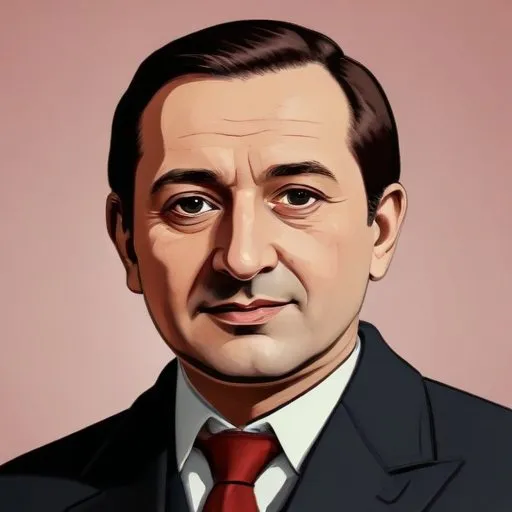
A Romanian literary giant, celebrated for his innovative poetry and sharp journalistic wit, leaving an indelible mark on Eastern European literature.
Tudor Arghezi, born Ion Nae Theodorescu, is renowned for his groundbreaking contributions to Romanian poetry and children's literature. With a career spanning over six decades, Arghezi has left an indelible mark on the literary world, earning him the reputation as one of Romania's most celebrated writers.
Born on May 21, 1880, in Bucharest, Romania, Arghezi's early life was marked by a strong passion for literature and the arts. He graduated from Saint Sava High School in 1896 and soon began publishing his works in various literary magazines, including Liga Ortodox, under the pseudonym Ion Theo.
It was during this period that Arghezi came under the mentorship of Alexandru Macedonski, the prominent Romanian Symbolist poet. Macedonski's praise for the young poet's work was instrumental in shaping Arghezi's early style, which was heavily influenced by Symbolism and other modernist trends.
Arghezi's literary career was marked by a flurry of publications, including poetry collections, novels, and children's books. Some of his most notable works include:
Arghezi's work is characterized by a deep sense of social consciousness and a commitment to progressive ideals. He was a vocal critic of social inequality and advocated for the rights of the working class and the peasantry. His writings often reflected his admiration for the beauty and simplicity of rural life, as well as his distrust of urbanization and industrialization.
In 1904, Arghezi co-founded the literary magazine Linia Dreapt (The Straight Line) with Vasile Demetrius, which became a platform for promoting modernist literature and art. He also spent time as an Orthodox monk at Cernica Monastery, an experience that had a profound impact on his spiritual and creative development.
In the early 1900s, Arghezi traveled extensively throughout Europe, visiting Paris and Fribourg, where he attended courses at the University of Fribourg. It was during this period that he developed a deep appreciation for the works of European modernists, such as Émile Zola and Henrik Ibsen.
Tudor Arghezi's contributions to Romanian literature are immeasurable. He is credited with helping to shape the country's modernist movement and inspiring generations of writers, poets, and intellectuals. His work continues to be widely read and studied in Romania, and his legacy serves as a testament to the power of literature to transform society and inspire positive change.
Today, Arghezi is remembered as a visionary poet, a passionate advocate for social justice, and a master storyteller who has left an indelible mark on the world of Romanian literature.
Born in 1850
A renowned Romanian writer and poet, celebrated for his romantic and patriotic works that explored the human condition, love, and national identity.
Born in 1881
Romanian Prime Minister who served briefly in 1938 and was a prominent poet and playwright, known for his nationalist and anti-Semitic views.
Born in 1895
A Romanian literary giant, celebrated for his avant-garde poetry and philosophical explorations of existence, culture, and human condition. His works are a testament to the country's rich cultural heritage.
