


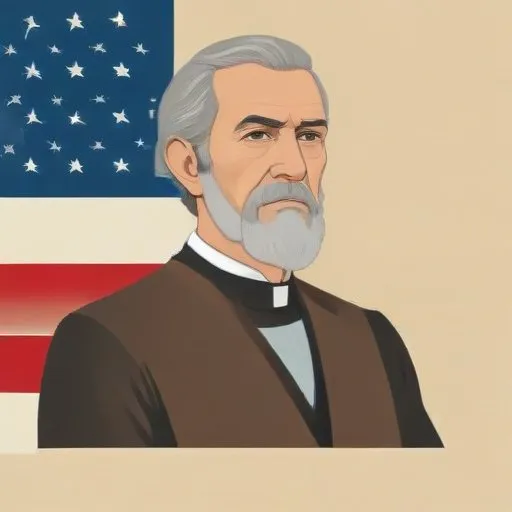
A 19th-century politician who served as Secretary of the Interior, advocating for education and conservation, and played a key role in post-Civil War Reconstruction. He's also known for being a Supreme Court Justice.
Lamar's childhood was marked by instability and tragedy. His father, a planter and lawyer, passed away when Lamar was just eleven years old. This led to a series of moves and an irregular education, which ultimately led him to settle in Oxford, Mississippi, where he studied law and was admitted to the bar in 1847.
In 1853, Lamar entered politics, winning a seat in the Mississippi House of Representatives. His strong oratory skills and unwavering commitment to states' rights propelled him to prominence, earning him a seat in the United States House of Representatives in 1857. During the American Civil War, Lamar served as a lieutenant colonel in the Confederate Army, and later, as a diplomat, working tirelessly to negotiate foreign recognition of the Confederacy.
After the war, Lamar worked to rebuild his state and his country. He played a pivotal role in drafting the Mississippi Constitution of 1868 and was elected to the United States Senate in 1870, where he served until 1877. In 1885, he became Secretary of the Interior under President Grover Cleveland, a position he held until 1889. Lamar's later life was marked by his dedication to education and his work as a chancellor of the University of Mississippi.
Lamar was a staunch advocate for states' rights and limited government intervention. He believed in the importance of individual liberty and the need for the federal government to respect the autonomy of the states. His oratory skills and persuasive arguments made him a respected figure in the Senate and House of Representatives.
Lamar's unwavering commitment to his beliefs, though often controversial, has left an indelible mark on American history. His dedication to education and public service has inspired generations of leaders and policymakers. Today, the Lamar House, his childhood home, stands as a testament to his legacy, serving as a museum and historical landmark in Oxford, Mississippi.
Lucius Quintus Cincinnatus Lamar II's life was marked by turmoil, tragedy, and triumph. Though his views on states' rights and limited government intervention may be controversial today, his dedication to public service, education, and the betterment of his country has left a lasting impact on American history. His legacy serves as a testament to the power of perseverance and the importance of standing by one's principles, even in the face of adversity.
45 Years Old
A dominant wide receiver in the NFL, known for his athleticism, sure hands, and impressive career statistics, earning him seven Pro Bowl selections.
Born in 1822
Led the Union Army to victory in the Civil War and later became President, known for issuing the Emancipation Proclamation and strengthening federal authority.
Born in 1822
The 19th President of the United States, a general, lawyer, and politician who ended the Reconstruction era and withdrew federal troops from the South, allowing Racial Segregation to begin. He's also known for being a strong supporter of education and civil service reform.
Born in 1831
The 20th President of the United States was a multifaceted leader who served as a general in the Civil War and later became a lawyer and politician, known for his strong advocacy for education and civil rights. He's also infamous for being assassinated just six months into his presidency.
Born in 1829
The 21st President of the United States, a strong advocate for civil service reform, is most known for signing the Pendleton Civil Service Act, which transformed the federal government's hiring practices. He's also remembered for his unexpected rise to presidency after the assassination of James A. Garfield.
Born in 1837
The first Democrat elected after the Civil War, he served two non-consecutive terms, earning him a unique spot in history, and is often remembered for his strong leadership and commitment to limited government.
Born in 1833
The 23rd President of the United States was a prominent leader who oversaw the admission of six new states to the Union and supported education and conservation efforts. He's also known for being the grandson of William Henry Harrison, the 9th President.
Born in 1843
The 25th President of the United States, a strong leader who championed high tariffs and annexed Hawaii, is most known for being assassinated at the 1901 World's Fair. He played a significant role in shaping the country's economy and foreign policy.
