


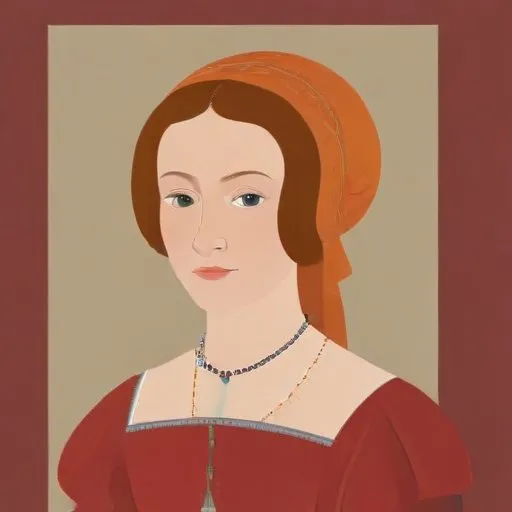
A member of the powerful Medici family, she was a patron of the arts and a skilled politician who played a key role in shaping the cultural and political landscape of 16th-century Italy.
Lucrezia de Medici, Duchess of Ferrara, is best known for being the inspiration behind Robert Browning's iconic poem, "My Last Duchess," written in 1842. This 16th-century noblewoman's life was marked by tragedy, mystery, and whispers of murder, leaving behind a lasting legacy that transcends time.
Born on February 14, 1545, in Florence, Lucrezia was the fifth child and third daughter of Cosimo I de Medici, Duke of Florence, and Eleanor of Toledo. Her family's rich history and noble lineage were only matched by the strict protocol and Spanish court ceremonial that governed her life. As a member of the Medici household, Lucrezia was afforded every luxury, but her freedom was severely curtailed, with even her daily interactions carefully regulated.
From a young age, Lucrezia's parents began searching for suitable husbands for their daughters. In the period between 1549 and 1550, she was considered as a potential bride for Don Pedro de Aragona y Cardona, 3rd Duke of Montalto. Later, in 1552, she was betrothed to Fabio Dal Monte, nephew of Pope Julius III, but the engagement was annulled after the Pope's death in 1555.
In 1558, Lucrezia was married to Alfonso II, Duke of Ferrara, Modena, and Reggio. This union was not one of love, but rather a strategic alliance between the Medici and the Este families. The marriage was short-lived and unhappy, with Lucrezia dying on April 21, 1561, at the tender age of 16. The official cause of death was pulmonary tuberculosis, but rumors of poisoning at the behest of her husband persisted, sparking gossip and speculation that would endure for centuries.
It was this very mystery surrounding Lucrezia's death that inspired Robert Browning to pen his haunting poem, "My Last Duchess." Through the voice of the duke, Browning crafts a chilling narrative that has captivated readers for generations, firmly cementing Lucrezia's place in the annals of literary history.
Though her life was marked by tragedy and constraint, Lucrezia de Medici, Duchess of Ferrara, has left an indelible mark on literature and history. Her story serves as a poignant reminder of the complexities of women's lives in the 16th century, while also highlighting the enduring power of art to immortalize even the most fleeting of human experiences.
In the centuries that have passed since her untimely death, Lucrezia de Medici, Duchess of Ferrara, has become an enigmatic figure, shrouded in mystery and intrigue. Yet, it is through her story that we gain a glimpse into the complex tapestry of 16th-century life, where politics, family, and art intersect in unexpected ways.
Born in 1449
Renaissance leader who ruled Florence and sponsored artists like Michelangelo and Botticelli, shaping the city's cultural and artistic heritage.
Born in 1389
Ruler of Florence who brought stability and prosperity to the city, patronizing artists and humanists, and establishing the Medici dynasty. He was a shrewd politician and banker who laid the groundwork for the Renaissance.
