


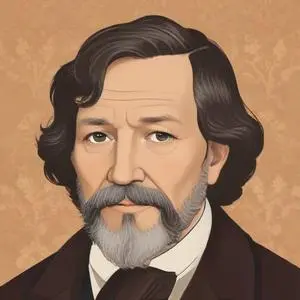
A Victorian-era literary giant, renowned for crafting intricate, psychologically nuanced poetry and plays that probed the human condition, often exploring themes of love, death, and the nature of existence.
Robert Browning, one of the most celebrated Victorian poets, is renowned for his innovative use of dramatic monologues, which revolutionized the poetry landscape. Through his works, he delved into the depths of human psychology, exploring complex emotions, and social commentary, cementing his position among the greatest poets of the era.
Born on May 7, 1812, in Walworth, Surrey, Browning was the only son of Robert Browning, a Bank of England clerk, and Sarah Anna Wiedemann. His paternal grandfather, a slave owner in Saint Kitts, West Indies, had a significant influence on Browning's abolitionist views, which would later manifest in his poetry.
Browning's early long poems, Pauline (1833) and Paracelsus (1835), garnered critical acclaim, establishing him as a prominent figure in the literary circle. However, his reputation suffered a temporary setback with the publication of Sordello in 1840, which was deemed too obscure by many critics.
In 1846, Browning married fellow poet Elizabeth Barrett, and the couple moved to Italy, where they drew inspiration from the country's rich cultural heritage. During this period, Browning's poetry underwent a significant transformation, marked by a shift towards a more personal and introspective style.
Browning's Men and Women (1855) collection showcased his mastery of dramatic monologues, while Dramatis Personae (1864) and the epic poem The Ring and the Book (1868-1869) solidified his position as a leading poet of the era. Through his works, Browning explored themes of love, death, and social justice, leaving an indelible mark on Victorian literature.
Browning's poetry reflects his deep-seated interest in philosophy, particularly in the works of Friedrich Nietzsche and Arthur Schopenhauer. His poems often grapple with existential questions, probing the human condition, and the nature of morality.
Browning's impact on modern society can be seen in the various literary and cultural movements that followed in his footsteps. His innovative use of dramatic monologues paved the way for modernist and postmodernist poets, while his exploration of complex emotions and social commentary continues to resonate with contemporary readers.
Throughout his career, Browning faced criticism for his perceived obscurity and complexity. However, his unwavering dedication to his artistic vision ultimately earned him widespread recognition and acclaim, cementing his status as a sage and philosopher-poet.
Browning's quotes and poems continue to inspire and captivate readers, offering a glimpse into the mind of a true literary genius.
Browning's life was marked by significant milestones, both personal and professional, which shaped his literary career and left an indelible mark on the world of poetry.
Born in 1806
A renowned poet and translator of the Victorian era, celebrated for her romantic and socially conscious works, particularly the iconic love poems "Sonnets from the Portuguese".
Born in 1809
Poet laureate of the United Kingdom during much of Queen Victoria's reign, famous for patriotic and romantic poems like "In Memoriam A.H.H." and "The Charge of the Light Brigade".
Born in 1812
A renowned author of timeless classics, crafting vivid stories that exposed social injustices and explored the human condition, leaving an indelible mark on literature.
Born in 1770
A major Romantic poet, known for his focus on nature, emotion, and the human experience, creating works that evoke a sense of wonder and connection to the natural world.
Born in 1772
A leading figure of the Romantic movement, he crafted vivid, imaginative poetry and explored the human experience through his writing and philosophical ideas. His works continue to inspire and influence literature and art to this day.
Born in 1795
Romantic poet celebrated for sensual language and vivid imagery, capturing the beauty of nature and human experience in odes like "To Autumn" and "Ode to a Nightingale".
Born in 1792
Romantic-era writer of lyrical poetry and Gothic dramas that explored the human condition, freedom, and the beauty of nature.
Born in 1797
Author of Gothic novels, particularly the iconic "Frankenstein", which has become a cultural phenomenon and influenced countless adaptations and reinterpretations.
