


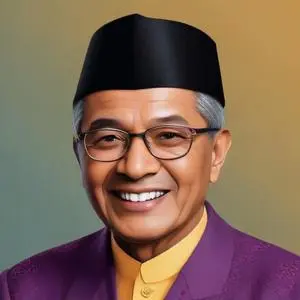
A Malaysian physician-turned-politician who served as Prime Minister twice, implementing economic reforms and promoting national unity. He's known for his strong leadership and nation-building efforts.
Mahathir Mohamad, the fourth and seventh Prime Minister of Malaysia, is renowned for his transformative leadership that propelled the country into a era of unprecedented growth and modernization. With a cumulative total of 24 years in office, he is the longest-serving prime minister in Malaysian history, leaving an indelible mark on the nation's politics, economy, and society.
Born on July 10, 1925, in Alor Setar, Kedah, Mahathir's journey in public service began in the 1940s, when he joined protests opposing citizenship policies for non-Malays in the Malayan Union. This early activism laid the foundation for his future political career, which spanned over seven decades.
Mahathir's entry into politics was facilitated by his membership in the United Malays National Organisation (UMNO), where he rose through the ranks to become a prominent figure. In 1964, he was elected as a Member of Parliament for Kota Star Selatan, marking the beginning of his long and eventful political career.
In 1970, Mahathir published his seminal book, The Malay Dilemma, which presented his vision for Malay empowerment and national unity. This influential work cemented his reputation as a thinker and a leader, and its ideas continue to resonate in Malaysian politics today.
Mahathir's first tenure as prime minister was marked by rapid modernization and economic growth. He initiated widespread industry privatization, embarked on ambitious infrastructure projects, and promoted national unity through his "Vision 2020" policy. His leadership during this period earned him the respect and admiration of Malaysians and international leaders alike.
In 2018, Mahathir made a remarkable comeback to politics, leading the Pakatan Harapan coalition to a historic victory in the general elections. At the age of 92, he became the world's oldest head of government, demonstrating his unwavering commitment to public service and his desire to correct the perceived wrongs of his predecessors.
Mahathir's legacy is complex and multifaceted, reflecting both his achievements and controversies. He is credited with transforming Malaysia into a modern, industrialized nation, while also being criticized for his authoritarian style of governance and human rights abuses. Despite these criticisms, Mahathir remains an iconic figure in Malaysian politics, revered by many for his vision, leadership, and dedication to the nation.
Mahathir's personal life has been marked by significant milestones, including his marriage to Siti Hasmah Mohamad Ali in 1956 and the birth of their seven children. He is also a trained physician, having graduated from the University of Malaya in 1953.
"The greatest glory in living lies not in never falling, but in rising every time we fall." - Mahathir Mohamad
"Malaysia is not a country that can be governed by a single race or a single religion. We must learn to live together in harmony and mutual respect."
Mahathir's leadership has been marred by controversies, including allegations of human rights abuses, corruption, and authoritarianism. His critics have accused him of suppressing dissent and undermining democratic institutions.
Despite these criticisms, Mahathir remains a polarizing figure in Malaysian politics, with many regarding him as a national hero and a champion of Malay rights.
1925: Born on July 10 in Alor Setar, Kedah
1940s: Joined protests opposing citizenship policies for non-Malays in the Malayan Union
1953: Graduated as a physician from the University of Malaya
1964: Elected as a Member of Parliament for Kota Star Selatan
1970: Published The Malay Dilemma
1981-2003: First tenure as Prime Minister of Malaysia
2018: Led the Pakatan Harapan coalition to victory in the general elections
2018-2020: Second tenure as Prime Minister of Malaysia
2022: Formed the Gerakan Tanah Air coalition
As Mahathir enters the twilight of his life, Malaysians and international observers alike are left to ponder his enduring legacy and the future of Malaysian politics. One thing is certain - Mahathir's impact on Malaysia will be felt for generations to come, shaping the nation's trajectory in ways both profound and unpredictable.
As we reflect on his remarkable journey, we are reminded of the words of Mahathir himself: "I am not a politician. I am a statesman." Indeed, Mahathir's life has been a testament to the power of statesmanship, a beacon of hope for a nation striving to find its place in an ever-changing world.
Born in 1923
The founder of modern Singapore, who transformed the country from a poor post-colonial state to a thriving economic powerhouse through visionary leadership and pragmatic policies. He is revered for his role in shaping Singapore's identity and prosperity.
Born in 1921
The authoritarian leader who ruled Indonesia for three decades, known for his iron-fisted governance and economic development, but also accused of human rights abuses and corruption.
98 Years Old
The 12th President of the Philippines, a decorated war hero and leader who implemented economic reforms and brought stability to the country after a tumultuous era. He's known for his efforts to modernize the Philippines and promote national unity.
93 Years Old
First female president of the Philippines, led the People Power Revolution, and restored democracy after decades of authoritarian rule.
81 Years Old
A democracy icon and human rights activist, she led the fight against Myanmar's military rule and was awarded the Nobel Peace Prize in 1991.
73 Years Old
The 6th Prime Minister of Malaysia, known for his corrupt practices and embezzlement of billions of dollars in the 1MDB scandal, leading to widespread protests and his eventual ousting. He is also known for his attempts to suppress dissent and free speech during his tenure.
86 Years Old
The 5th Prime Minister of Malaysia, serving from 2003 to 2009, known for his efforts to promote Islamic values and moderate politics in a multicultural society. He implemented various reforms, including anti-corruption measures and economic development plans.
Born in 1922
A Malaysian lawyer and politician who served as the country's third Prime Minister, known for his efforts to reduce racial tensions and promote national unity. He's also credited with establishing the New Economic Policy to eradicate poverty and redistribute wealth.
