


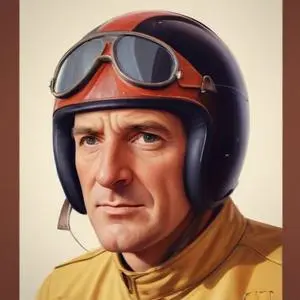
A British racing legend who set multiple world water and land speed records in the 1920s and 1930s, earning him the nickname "Speed King."
Malcolm Campbell, a British racing motorist and motoring journalist, etched his name in the annals of history by setting multiple world speed records on land and water, earning him the nickname "Speed King." Between 1924 and 1939, Campbell consistently pushed the boundaries of speed, using his iconic vehicles, Blue Bird, to achieve unprecedented velocities.
Born on March 11, 1885, in Chislehurst, Kent, Campbell's fascination with speed and machines began early. He attended the prestigious Uppingham School, where his enthusiasm for motorbikes and racing grew. After learning the diamond trade in Germany, Campbell returned to Britain, working for Lloyds of London and later participating in various motorcycle races, winning all three London to Lands End Trials between 1906 and 1908.
In 1910, Campbell transitioned to car racing at Brooklands, christening his vehicle Blue Bird, inspired by the play The Blue Bird by Maurice Maeterlinck. This marked the beginning of his illustrious racing career, which spanned over three decades. Campbell's dedication to innovation and perfection drove him to continually refine his vehicles, propelling him to achieve record-breaking speeds.
During World War I, Campbell served as a motorcycle dispatch rider and later commissioned as a second lieutenant in the 5th Battalion, Queens Own Royal West Kent Regiment. Following the war, he pursued writing, penning motoring mystery novels, including Salute to the Gods, which was adapted into the 1939 film Burn 'Em Up O'Connor.
Campbell's personal life was marked by three marriages, first to Marjorie Dagmar Knott in 1913, then to Dorothy Evelyn Whittall in 1920, with whom he had two children, Donald and Jean. His final marriage was to Betty Nicory in 1945. Campbell's family life was often tumultuous, with his second wife, Dorothy, describing him as "quite unfitted for the role of husband and family man."
Campbell's unwavering passion for speed and innovation left an indelible mark on the world of motorsports. His records inspired future generations, including his son, Donald Campbell, who carried on the family tradition by holding both land and water speed records. Today, Malcolm Campbell's legacy serves as a testament to the power of human achievement and the unrelenting pursuit of excellence.
Born in 1896
Pioneering speed demon who set multiple world water and land speed records in the 1920s, including being the first to break the 200mph barrier.
Born in 1896
A British aristocrat who combined military duty with a passion for high-speed racing, setting multiple records and winning numerous competitions. He's most famous for his Bentley racing exploits.
Born in 1881
Founded the luxury car brand Bugatti, creating iconic, high-performance vehicles that epitomize style and sophistication. His designs continue to inspire and influence the automotive industry.
Born in 1898
Founder of the iconic luxury sports car brand and racing team, known for his passion for speed and innovative designs. He revolutionized the automotive industry with his sleek, high-performance vehicles.
Born in 1911
A five-time Formula One World Champion, known for his dominance and innovative driving style in the 1950s.
97 Years Old
A legendary racing driver and sportscaster who won 16 Formula One Grands Prix and was inducted into the Motorsport Hall of Fame, known for his exceptional driving skills and charismatic commentary.
