


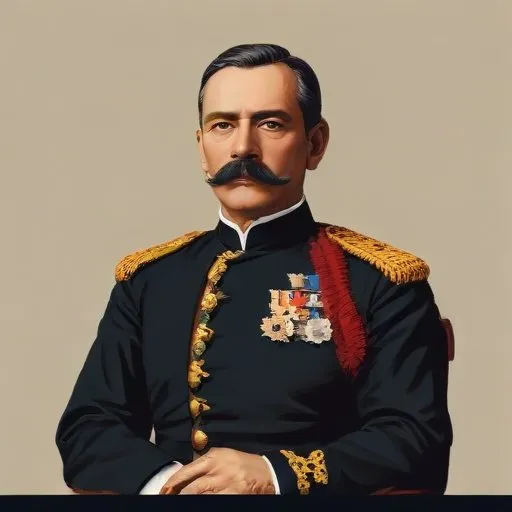
Manuel González Flores, the 35th President of Mexico, is remembered for his remarkable diplomatic and domestic achievements, which transformed the country during his presidency from 1880 to 1884. As a military general and liberal politician, González played a pivotal role in shaping Mexico's history, leaving an indelible mark on the nation.
Born in Matamoros, Tamaulipas, Mexico, on June 17, 1833, González's early life was marked by a strong educational foundation, thanks to his supportive parents, Fernando González and Eusebia Flores de la Garza. His parents' influence and the death of his father led him to return to his birthplace, where he worked as a merchant under the care of his uncle.
González's entry into the military marked the beginning of his ascent to power. As a lieutenant during the Mexican-American War, he demonstrated his bravery and strategic prowess. Later, as a general on the conservative side during the Reform War, he further solidified his reputation as a skilled military leader. His allegiance to General Porfirio Díaz during the French intervention in Mexico earned him a prominent position in the Mexican Republic.
After serving as Mexican Secretary of War in the Díaz administration from 1878 to 1879, González became the President of Mexico in 1880, largely due to Díaz's efforts to secure the presidency for his protégé. During his four-year tenure, González oversaw significant diplomatic and domestic advancements, which historian Friedrich Katz has described as "the profound transformation of Mexico."
González's presidency has been marred by allegations of corruption, which some historians attribute to the difficult financial circumstances of 1884 and Díaz's subsequent campaign to discredit his successor. Despite these controversies, González's achievements have endured, shaping Mexico's trajectory for generations to come.
"The nation's progress depends on the unification of its forces, and I am committed to achieving this union, even at the cost of my own life."
González's personal life was marked by significant milestones, including his marriage to María Hernández y Hernández, with whom he had eight children. His dedication to education and family was reflected in his support for the establishment of the National Teachers' College.
Manuel González Flores' presidency took place during a tumultuous period in Mexican history, marked by foreign interventions and internal power struggles. Despite these challenges, he managed to leave a lasting impact on the country, paving the way for future generations of leaders. His legacy continues to inspire and inform Mexican politics to this day.
Manuel González Flores' remarkable presidency and military career have secured his place in Mexican history. Despite controversies surrounding his legacy, his achievements continue to shape the nation, serving as a testament to his vision and leadership.
Born in 1830
A Mexican general and politician who ruled Mexico with an iron fist from 1876 to 1911, modernizing the country while suppressing dissent and opposition. He's infamous for his authoritarian regime and eventual exile.
Born in 1806
A champion of democracy and indigenous rights, he modernized Mexico, abolished slavery, and limited church power. He's revered as a national hero for his progressive reforms.
Born in 1823
Interim President of Mexico who served for a brief period in 1823, known for his role in the country's early independence and formation.
Born in 1832
Unconstitutional president of Mexico who briefly seized power in 1832, known for his short-lived and tumultuous reign.
Born in 1823
The 32nd President of Mexico, serving from 1872 to 1876, known for his liberal reforms and modernization efforts, particularly in education and infrastructure.
Born in 1877
Mexican revolutionary leader who served as president from 1924 to 1928, known for implementing secular and anti-clerical policies, including restricting the Catholic Church's power. He also founded the National Revolutionary Party, which later became the dominant party in Mexico.
