


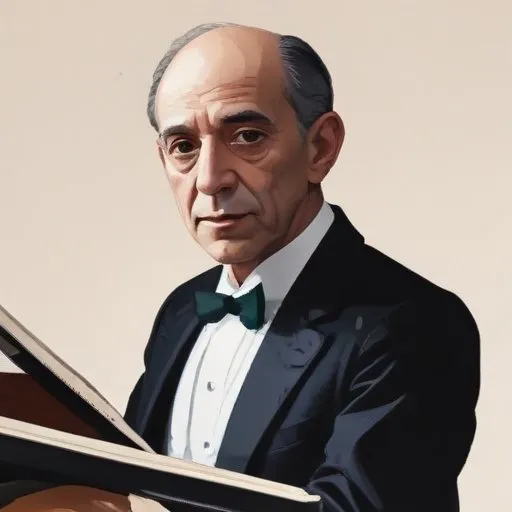
A renowned Spanish pianist and composer, known for blending folk influences with modernist techniques, creating iconic works like "The Three-Cornered Hat" and "Nights in the Gardens of Spain".
Known for his captivating compositions that blended traditional Spanish folk music with modernist influences, Manuel de Falla is widely regarded as one of Spain's most important musicians of the 20th century. His innovative works, including Nights in the Gardens of Spain and The Three-Cornered Hat, continue to enthrall audiences worldwide, cementing his legacy as a master composer.
Born in Cádiz, Spain on November 23, 1876, Manuel de Falla y Matheu was the son of José María Falla, a Valencian, and María Jesús Matheu, from Catalonia. He began taking piano lessons at the age of nine and later continued his studies with Alejandro Odero, learning harmony and counterpoint from Enrique Broca.
In 1900, de Falla's family moved to Madrid, where he attended the Real Conservatorio de Música y Declamación. During this period, he composed several works, including Meloda for Cello and Piano, and premiered his first pieces, including Romanza para violonchelo y piano and Nocturno para piano. His talent was soon recognized, and in 1899, he was awarded the first prize at the piano competition at his school of music.
De Falla's unique blend of traditional Spanish music and modernist influences earned him international recognition. His compositions, such as The Three-Cornered Hat, a ballet score, and Nights in the Gardens of Spain, a piano concerto, showcased his mastery of orchestration and melody. His music often featured complex harmonies, intricate rhythms, and vivid instrumental textures, which captivated audiences and critics alike.
De Falla's contributions to Spanish music were immense. He, along with Isaac Albéniz, Francisco Tárrega, and Enrique Granados, played a crucial role in shaping the country's musical identity. His innovative style and compositions inspired a new generation of Spanish composers, ensuring his legacy in the world of music.
In 1939, de Falla moved to Argentina, where he lived until his death on November 14, 1946. During his later years, he continued to compose, albeit at a slower pace, and remained dedicated to his craft. De Falla's personal life was marked by simplicity and frugality, which he believed allowed him to focus on his music.
Manuel de Falla's impact on Spanish music and culture is immeasurable. His compositions continue to be performed and admired worldwide, and his influence can be seen in the works of countless Spanish composers who followed in his footsteps. Today, he is remembered as a visionary who brought modernity to traditional Spanish music, leaving behind a rich legacy that continues to inspire and delight audiences.
Born in 1860
A renowned Spanish pianist and composer, he's celebrated for his evocative and expressive works that blended folk influences with classical music, particularly his iconic suite "Iberia".
Born in 1867
A renowned Spanish pianist and composer, known for his romantic and expressive works, particularly his piano suite "Goyescas", which is considered a masterpiece of Spanish music.
Born in 1862
A renowned French pianist and composer who revolutionized classical music with his unique, dreamy, and unconventional style, creating iconic works like "Clair de Lune" and "Prelude to the Afternoon of a Faun".
Born in 1875
A renowned French musician who blended classical and modern styles, creating iconic works like "Bolero" that continue to mesmerize audiences with their beauty and complexity.
Born in 1893
A renowned Spanish artist, famous for his vibrant, dreamlike paintings and sculptures that blended abstraction and surrealism, creating a unique visual language. His works often featured bold colors, biomorphic forms, and a sense of playfulness.
Born in 1904
A renowned surrealist master of bizarre, dream-like paintings and sculptures that blur reality and fantasy, known for iconic works like "The Persistence of Memory" and "The Elephants".
Born in 1898
A Spanish poet, playwright, and director who explored themes of love, death, and Spanish culture through his works, including the famous play "Blood Wedding".
Born in 1893
Renowned for popularizing classical guitar music and transcribing classical masterpieces for the instrument, he elevated the guitar's status as a concert instrument.
