


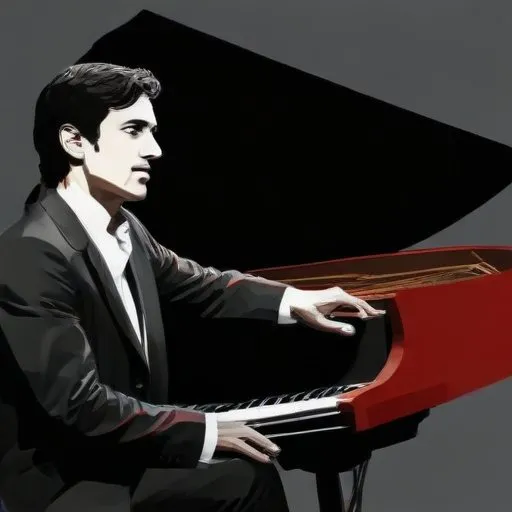
A renowned Spanish pianist and composer, known for his romantic and expressive works, particularly his piano suite "Goyescas", which is considered a masterpiece of Spanish music.
Enrique Granados, a Spanish composer and concert pianist, is renowned for his captivating works that evoke the essence of Spanish culture. His magnum opus, Goyescas, a suite of six pieces inspired by Francisco Goya's paintings, is a testament to his innovative spirit and exceptional craftsmanship.
Born on July 27, 1867, in Lleida, Spain, Granados was the son of Calixto José de la Trinidad Granados y Armenteros, a Spanish army captain, and Enriqueta Elvira Campià de Herrera, from Santander, Spain. He began his musical journey in Barcelona, studying piano under the tutelage of Francisco Jurnet and Joan Baptista Pujol.
In 1887, Granados traveled to Paris to further his education, where he received private lessons from Charles-Wilfrid de Bériot, a professor at the Paris Conservatoire. This period greatly influenced his teaching style, particularly in pedal technique, and fostered his improvisational skills. His studies with Felip Pedrell, a prominent Catalan composer, also played a significant role in shaping his musical identity.
Granados' breakthrough came at the end of the 1890s with the opera Mara del Carmen, which caught the attention of King Alfonso XIII. This recognition marked the beginning of his successful career, solidifying his position as a prominent figure in Spanish classical music.
In 1903, Granados participated in a competition organized by Tomás Bretón of the Madrid Royal Conservatory, where he submitted his Allegro de concierto, Op. 46. The jury declared him the winner with an almost unanimous vote, awarding him a significant sum of 500 pesetas. This triumph brought Granados to national attention, securing his reputation as a master composer.
In 1911, Granados premiered his iconic suite for piano, Goyescas, inspired by Francisco Goya's paintings. This work not only showcased his exceptional craftsmanship but also demonstrated his ability to evoke the essence of Spanish culture. The success of Goyescas encouraged Granados to expand the work, ultimately creating a masterpiece that would become synonymous with Spanish classical music.
Granados' later works continued to showcase his innovative spirit and exceptional skill. His Danza Españolas, a set of 12 pieces for piano, is a testament to his ability to craft beautiful, lyrical melodies that captivate audiences worldwide.
Enrique Granados' contributions to Spanish classical music are immeasurable. His works have inspired generations of composers and continue to be celebrated for their beauty, elegance, and cultural significance. His legacy extends beyond the realm of music, serving as a testament to the power of art to evoke the essence of a nation's culture.
Enrique Granados' life was tragically cut short in 1916, when he and his wife drowned in the English Channel after the ship they were traveling on, the SS Sussex, was torpedoed by a German U-boat. Despite his untimely passing, Granados' legacy continues to inspire and captivate audiences worldwide, cementing his position as one of the most important figures in Spanish classical music.
Born in 1860
A renowned Spanish pianist and composer, he's celebrated for his evocative and expressive works that blended folk influences with classical music, particularly his iconic suite "Iberia".
Born in 1876
A renowned Spanish pianist and composer, known for blending folk influences with modernist techniques, creating iconic works like "The Three-Cornered Hat" and "Nights in the Gardens of Spain".
Born in 1867
A renowned Spanish pianist and composer, known for his romantic and expressive works, particularly his piano suite "Goyescas", which is considered a masterpiece of Spanish music.
Born in 1882
A Spanish-French composer, critic, and educator who blended folk influences with classical music, creating a unique and expressive style. His works include orchestral pieces, chamber music, and operas.
Born in 1893
Renowned for popularizing classical guitar music and transcribing classical masterpieces for the instrument, he elevated the guitar's status as a concert instrument.
Born in 1876
A renowned Catalan musician, he was a master cellist and conductor, celebrated for his expressive performances and interpretations of Bach's cello suites. He's also credited with popularizing classical music globally.
Born in 1895
A renowned pianist and conductor, known for his virtuosic performances and interpretations of classical music, particularly in the romantic repertoire.
