


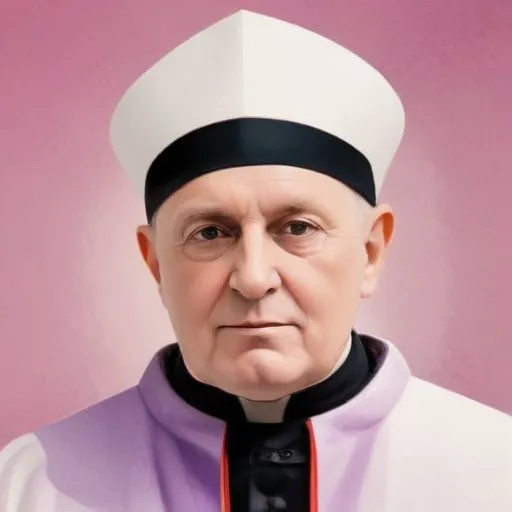
A French-Swiss archbishop and theologian who led a traditionalist movement within the Catholic Church, opposing liberal reforms and advocating for a return to pre-Vatican II practices. He founded the Society of St. Pius X, a priestly society dedicated to preserving traditional Catholicism.
Marcel Lefebvre is renowned for his unwavering commitment to traditional Catholicism, culminating in the establishment of the Society of Saint Pius X (SSPX) in 1970, a community dedicated to preserving the Church's timeless traditions. As a vocal critic of the Second Vatican Council's modernizing reforms, Lefebvre's unrelenting stance has made him a polarizing figure in Catholic circles.
Born on November 29, 1905, in Tourcoing, France, Marcel Lefebvre was ordained as a diocesan priest in 1929. He soon joined the Holy Ghost Fathers, undertaking missionary work and teaching at a seminary in Gabon from 1932. His leadership abilities propelled him to prominent positions, including Vicar Apostolic of Dakar, Senegal (1947), and Apostolic Delegate for West Africa (1948).
Lefebvre's reputation as a staunch traditionalist solidified during the Second Vatican Council (1962-1965), where he played a key role in drafting and preparing documents. As a leader of the conservative bloc, he clashed with liberal-minded reformers, advocating for the preservation of the Church's traditional practices and dogma. His influence extended to participating in the drafting of the council's documents, solidifying his position as a champion of Catholic orthodoxy.
In 1970, Lefebvre established the SSPX as a small community of seminarians in the village of Écône, Switzerland, with the permission of the local bishop. This bold move was a direct response to the Vatican Council's perceived departures from traditional Catholicism, which he believed threatened the very fabric of the Church. The SSPX's founding marked the beginning of a new era in Catholic traditionalism, with Lefebvre at its helm.
Lefebvre's defiance of the Holy See's authority reached its zenith in 1988, when he consecrated four bishops against Pope John Paul II's express prohibition. This act of disobedience led to his excommunication, a decision he contested, citing an alleged agreement with the Holy See. The consecration crisis sparked widespread controversy, with Lefebvre's opponents labeling him a schismatic and his supporters hailing him as a hero of Catholic orthodoxy.
Marcel Lefebvre's unwavering commitment to traditional Catholicism has left an indelible mark on modern Catholicism. His legacy extends beyond the SSPX, influencing a new generation of traditionalist Catholics and sparking debates about the role of tradition in the Church. While his actions have been met with both praise and condemnation, his unshakeable conviction has secured his place as a pivotal figure in Catholic history.
Marcel Lefebvre's life and ministry serve as a testament to the tumultuous period of Catholic history following the Second Vatican Council. His steadfast commitment to traditional Catholicism has inspired both fervent admiration and vehement criticism. As the Church continues to navigate the complexities of modernity, Lefebvre's legacy serves as a beacon for those seeking to preserve the timeless traditions of the Catholic faith.
Born in 1417
A 15th-century pope who played a significant role in the fall of the Western Schism, ending the division in the Catholic Church. He's also known for his lavish spending and nepotism.
