


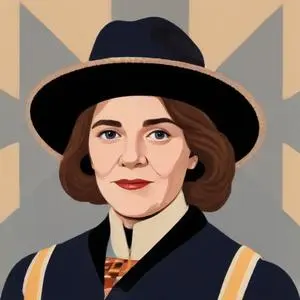
A wealthy socialite turned women's rights advocate and Titanic survivor, known for her bravery and humanitarian work, particularly in education and women's suffrage.
Margaret Brown, posthumously known as the Unsinkable Molly Brown, was an American socialite and philanthropist who defied death and inspired a generation with her courage and determination in the face of tragedy. She is best known for surviving the RMS Titanic disaster of 1912, and her unwavering efforts to rescue fellow passengers.
Margaret Tobin was born on July 18, 1867, in Hannibal, Missouri, to Irish Catholic immigrant parents John Tobin and Johanna Collins Tobin. She was the second of six children, including siblings Daniel, Michael, William, and Helen Tobin, as well as two half-sisters from her parents' previous marriages.
The family lived in a tight-knit Irish Catholic community, where Margaret attended her maternal aunt Mary O'Leary's grammar school. Her father worked as a laborer at the nearby Hannibal Gas Works. The neighborhood was a hub of activity, with people traveling westward through the town for the gold fields.
At the age of 18, Margaret relocated to Leadville, Colorado, with her siblings and brother-in-law. She shared a two-room log cabin with her brother Daniel and found work sewing carpets and draperies at a dry goods store, Daniels, Fisher and Smith. Daniel worked as a miner, and the town was bustling with mining activity.
In 1886, Margaret married James Joseph Brown, a mining engineer, and the couple had two children, Lawrence Palmer Brown and Helen Margaret Brown. The family lived a comfortable life, with James working as the superintendent of the Ibex Mining Company.
In 1912, Margaret and her husband boarded the RMS Titanic at Cherbourg, France, for a trip to New York City. Tragically, the ship struck an iceberg and sank, resulting in the loss of over 1,500 lives. Margaret helped other passengers board lifeboats and encouraged the crew to return to the debris field to look for survivors.
Her heroism and bravery during the disaster earned her the nickname "Unsinkable Molly Brown," and she became an overnight sensation in the media. Her story inspired countless people and cemented her place in history as a symbol of courage and determination.
After the Titanic disaster, Margaret continued to work tirelessly for social and political causes. She supported women's rights, labor unions, and education, and was a vocal advocate for the rights of workers and the poor. She ran for the Colorado State Legislature in 1914, but lost the election.
Margaret Brown passed away on October 26, 1932, at the age of 65, but her legacy lives on as an inspiration to generations of people around the world. Her story is a testament to the power of courage, determination, and compassion in the face of adversity.
Margaret Brown's legacy extends far beyond her heroic actions during the Titanic disaster. She was a pioneer for women's rights, a champion of social justice, and a devoted philanthropist. Her unwavering spirit and generosity have inspired countless people to make a positive impact on the world.
In addition to her humanitarian work, Margaret Brown's story has been immortalized in literature, film, and theater. She has been the subject of numerous books, plays, and films, including the 1960 Broadway musical "The Unsinkable Molly Brown," which was adapted into a film in 1964.
Today, Margaret Brown's birthplace in Hannibal, Missouri, is a museum dedicated to her life and legacy. Her story continues to captivate audiences and inspire people to make a difference in the world.
Born in 1864
A wealthy businessman and member of the prominent Astor family, he played a significant role in the development of New York City's iconic Waldorf-Astoria Hotel.
Born in 1845
German-American businessman and co-owner of the Macy's department store chain, who went down with the Titanic and became a symbol of courage and loyalty. He was a member of the New York State Senate and a prominent figure in the German-American community.
Born in 1865
Wealthy owner of the American Smelting and Refining Company, who tragically went down with the Titanic, famously declaring "We've dressed up in our best and are prepared to go down like gentlemen!"
Born in 1889
Early 20th-century film star and singer who pioneered the "it girl" persona, starring in silent films and recording popular songs.
Born in 1865
A U.S. Army officer who served as a military aide to U.S. presidents Theodore Roosevelt and William Howard Taft, and is best known for his heroic actions during the sinking of the RMS Titanic.
Born in 1894
Heir to the John B. Thayer fortune, survived the Titanic's sinking, and later wrote a detailed account of the tragedy.
